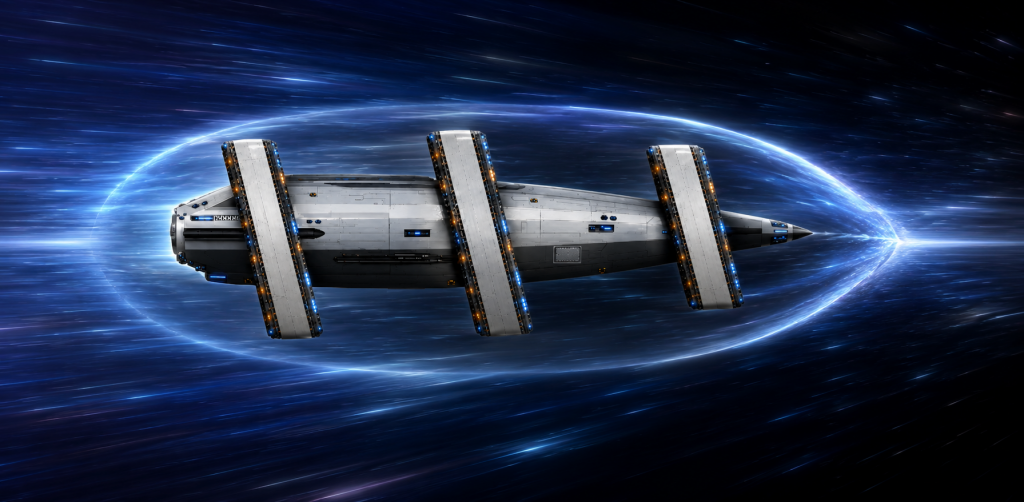
Starship Adventures has commissioned the Scout Class Starship series to:
- Provide a spacefaring vehicle for explorative, scientific, and scouting research projects in deep space.
- Incorporate and evaluate recent advancements in warp power plant technology and newly developed space vehicle instrumentation.
The Scout Class Starship is Starship Adventures’ first-generation extra solar system explorer type vessel. It is a vessel designed for a non-experience crew with minimal training giving the average person the opportunity to experience the adventure of space travel and exploration.
The crew’s inexperience and diversity will help allow exploration in ways will enable members to learn how to work together, or fail to, depending on the circumstances they encounter. Their experience will allow Starship Adventures to improve on mission protocols and technology.
Vessel Mandate
The Scout Class is an unarmed exploration and scientific survey vessel. Per the vessel specification, it carries no conventional tactical or weapons systems; its design emphasizes state-of-the-art propulsion, advanced and experimental sensor suites, and scientific instrumentation. Accordingly, this specification defines no weapons systems. The Defensive & Situational Awareness System (DSA) provides situational-awareness and self-protection functions as an explorer vessel genuinely requires — contact detection, hazard tracking, threat assessment, evasion, and non-weapon countermeasures.
The console architecture remains forward compatible with an optional tactical module for armed refits or non-exploratory Scout Class variants, but no such module is fitted on standard exploration vessels.
Vessel Specifications
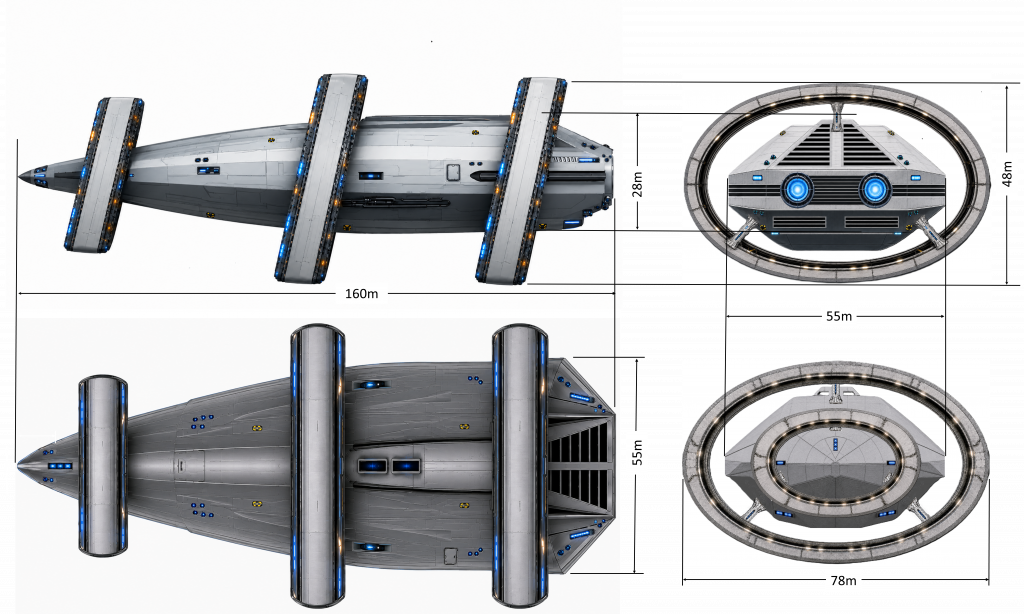
| Length | 160 m | |
|---|---|---|
| Airlocks | 2 | · Passenger / Crew Boarding |
| · Cargo, supplies, EVA/maintenance access | ||
| Beam (max) | Hull | 55 m |
| Warp Rings | 78 m | |
| Complement | Maximum | 16 |
| Officers | 3-Feb | |
| Crew | 10-Mar | |
| Staff | 2 | |
| Computers | 3 | Modular redundancy, local autonomous controllers, physical safety interlocks, and manual fallback controls |
| Computer Networks | 7 | Multiple isolated networks |
| Operating System | SCOUT | Scout Class Operating Umbrella Technology |
| Energy Storage | Capacitor banks | |
| SMES | Superconducting Magnetic Energy Storage | |
| Fuel | D-He3 fusion | |
| Deuterium | 12 metric tons | |
| Helium-3 | 18 metric tons | |
| Height (max) | Hull | 28 m |
| Warp Rings | 48 m | |
| Hull Type | Unified lifting body | Multiple hull architecture. |
| Inner Hull | Water Shielding Cells | 0.5–1.0 m local depth around habitable zones |
| Pressure Liner | 0.075 m | |
| Interior Finish/Acoustic Wall | 75 mm (variable) | |
| Inter Hull | Service Gap | 1.5 m (average) |
| Keel Spine | Material | Carbon-Titanium composite true |
| Life Pods | None | The Scout Class uses hardened emergency survival compartments rather than conventional lifeboats for deep-space mission profiles. |
| Life Support | Distributed regenerative Environmental Control and Life Support System (ECLSS) | |
| Mission Duration | Typical | 5 to 14 days |
| Maximum Endurance | 20 days (with full crew compliment) | |
| Number of Decks | 6 | Accessible by Lift, Stairs, and Ladders |
| Outer Pressure Hull | Thermal/Armor Skin | 100 mm |
| Micrometeoroid Bumper Spacing | 300 mm | |
| Material | ||
| Laminated titanium composite | ||
| Power Source | Field-Reversed Configuration reactor (FRC) | Qty: 2 |
| Propulsion | Sub Light | 2 High-Power Plasma / Ion Hybrid Drives |
| Super Luminal | Alcubierre-type Hybrid | |
| Maneuvering Thrusters | Reaction Control System (RCS) | 6 Lateral Thrusters |
| 6 Vertical Thrusters | ||
| 4 Axial Trim Thrusters | ||
| Radiator Supports | Material | High-temperature ceramics composite |
| Range | Sublight | 9 AU’s |
| Superluminal (standard cruise) | 100 light years | |
| Superluminal (extended cruise) | 300 light years | |
| Ring Frames | Material | Graphene-reinforced alloy |
| Shields | Sublight Shield | High-Velocity Particle Protection System (HVPPS) |
| Hull Penetration Response System (HPRS) | ||
| Stern Propulsion Block | 20 m X 10 m | |
| Exploratory Drones | Class 1-Survey & Inspection | 6 |
| Class 2-Planetary Reconnaissance | 2 | |
| Class 3- Expendable Probes | 2 (Mission Dependent) | |
| System User Interface | AI | Voice |
| Consoles and User Personal Data Pads | SCOUT-Scout Class Operating Umbrella Technology | |
| Velocity | Sub Light Normal Cruise | 0.005c to 0.01c |
| Sub Light Max Emergency | 0.03c | |
| Vessel Center of Gravity | Longitudinal Target | Near mid-body, approx. 75–85 m from bow |
| Vertical Target | Below geometric centerline | |
| Lateral Target | On vessel centerline | |
| Control Method | Water shielding transfer, fuel balancing, ballast trim, software-controlled mass management | |
| Primary Mass Concentrations | Water shielding, keel spine, reactors, fuel tanks, warp pylons, propulsion block | |
| Mass Balance Requirement | Maintain symmetry for sublight maneuvering and warp-field stability | |
| Vessel Mass | Loaded | 40,000 t |
| Dry Mass, estimated | 25,000-28,000 t | |
| Consumables / Fluids / Fuel | 12,000-15,000 t | |
| D-He3 Fusion Fuel (reactor; 12 t D + 18 t He-3) | 30 t | |
| RCS Hydrazine Propellant (separate monopropellant) | 50 t | |
| Water Shielding / Ballast | 10,000-14,000 t | |
| Structural Mass | 8,000-10,000 t | |
| Propulsion / Power Systems | 4,000-6,000 t | |
| Habitat//Interior/Life support | 2,000-3,000 t | |
| Design Growth Margin | 10%-15% | |
| Fusion fuel and cryogenic storage | 1,500 t | |
| Maintenance spares / tools | 500 t | |
| Warp Pylons | Material | Superconducting composite truss |
| Warp Rings | 3 Alcubierre-type Hybrid | Forward ring |
| Mid ring | ||
| Aft ring | ||
| Weapons | None | |
Design Philosophy Factors
- Exploration rather than combat
- Safety over performance
- Redundancy over efficiency
- Automation supporting humans
- Civilian operability
- Scientific capability
- Mission immersion
- Maintainability
Crew Roles
The vessel provides accommodations for sixteen personnel consisting of one Captain’s Suite, thirteen standard crew cabins, one Steward Cabin, and one Culinary Officer Cabin.
Command Staff
Command staff is the highest leadership on board a ship. This would include the Captain, First, Second, and Third Officers.
| Position | Description |
| Captain | The Captain is the ultimate commander of the spaceship. He/she is responsible for its safe and efficient operation and ensuring that the vessel complies with legal and company policies. All people on board, including officers, crew, passengers and guests are under the Captain’s authority and are his/her ultimate responsibility. For most situations, the Captain has the final say in almost all matter. |
| First Officer | The First Officer is second-in-command after the captain and the head of the Bridge Department on a vessel. The First Officer assumes command of the whole ship in the absence or incapacitation of the Captain. More details on the First Officer’s role is described in the Bridge section. |
| Chief Engineer | The Chief Engineer is the head of the Engineering Department. The Chief Engineer assumes command of the whole ship in the absence or incapacitation of the Captain, First Officer. More details on the Chief Engineer under the Engineering section. |
| Communications Specialist | The Communications Specialist is responsible for the operation, monitoring, analysis, and management of all external and internal communications systems aboard the Scout Class Starship. While often associated with message traffic, the Communications Specialist performs a much broader role that includes signal analysis, long-range communications, drone coordination, telemetry monitoring, electronic intelligence gathering, emergency communications management, and information routing throughout the vessel. The Communications Specialist serves as the ship’s primary expert in the collection, interpretation, and distribution of information originating beyond the vessel itself. |
Crew Staff
| Position | Description | # of crew |
| Mission Specialists | Mission Specialists are crew members assigned to temporary roles based on mission requirements. They are not officers and do not participate in the chain of command, but they are considered part of the crew and contribute directly to mission success. For example: – Exploration Specialist – Survey Specialist – Rescue Specialist – Diplomatic Specialist – Archaeological Specialist – Astrometric Specialist – Security Specialist – Technology Evaluation Specialist – Intelligence Specialist – Xenobiology Specialist – Planetary Science Specialist – Systems Specialist – Logistics Specialist | Mission Dependent |
| Operational Specialists | Mission Specialists are crew members assigned to temporary roles based on mission requirements. They are not officers and do not participate in the chain of command, but they are considered part of the crew and contribute directly to mission success. For example: Exploration Specialist Survey Specialist Rescue Specialist Diplomatic Specialist Archaeological Specialist Astrometric Specialist Security Specialist Technology Evaluation Specialist Intelligence Specialist Xenobiology Specialist Planetary Science Specialist Systems Specialist Logistics Specialist | Mission Dependent |
| Medic | The Medic provides health care services, gives necessary treatment for the sick and wounded. Not a full-time position given the total crew compliment. At least one crew member is required to have first aid training. Typically combined with the Chief Steward position. Responsibilities: – First aid – Emergency response – Medical assistance Duties: – Operate medical monitoring equipment – Assist patients – Support telemedicine consultations – Maintain medical supplies – Manage isolation room logistics During a medical emergency: – Medical AI provides diagnostics – Chief Steward provides hands-on support – Captain and command staff coordinate response For typical missions a crew member usually if First Aid certified. | Mission Dependent |
| Chief Steward | Reports To: First Officer Crew Welfare The Chief Steward is responsible for crew welfare, accommodation, hospitality services, guest experience, logistics support, and morale. The position ensures that the crew can focus on mission objectives while maintaining a safe, comfortable, and professional living environment. Responsibilities: Monitor crew fatigue Monitor morale Monitor interpersonal conflicts Monitor passenger well-being Recommend rest periods Coordinate recreation activities Accommodations Management Responsible for: Cabin assignments Cabin readiness Linen service Hygiene supplies Lost-and-found items Public area standards For embarkation: Prepare cabins Welcome arriving crew Provide orientation materials Answering questions Passenger Experience This is particularly important for Starship Adventures. Responsibilities: Crew onboarding Mission orientation Guest assistance Problem resolution The Chief Steward becomes the primary point of contact when guests need help but do not need command staff. Examples: A guest is confused about their role. A guest misses a briefing. A guest has dietary concerns. A guest needs assistance using ship systems. Hospitality Operations Oversees: Lounge operations Meeting room readiness Observatory hospitality support Special events Celebration dinners Coordinates closely with the Chef. | Mission Dependent |
| Medic | The Medic provides health care services, gives necessary treatment for the sick and wounded. Not a full-time position given the total crew compliment. At least one crew member is required to have first aid training. Typically combined with the Chief Steward position. Responsibilities: First aid Emergency response Medical assistance Duties: Operate medical monitoring equipment Assist patients Support telemedicine consultations Maintain medical supplies Manage isolation room logistics During a medical emergency: Medical AI provides diagnostics Chief Steward provides hands-on support Captain and command staff coordinate response For typical missions a crew member usually if First Aid certified. | |
| Chief Steward | Reports To: First Officer Crew Welfare The Chief Steward is responsible for crew welfare, accommodation, hospitality services, guest experience, logistics support, and morale. The position ensures that the crew can focus on mission objectives while maintaining a safe, comfortable, and professional living environment. Responsibilities: – Monitor crew fatigue – Monitor morale – Monitor interpersonal conflicts – Monitor passenger well-being – Recommend rest periods – Coordinate recreation activities Accommodations Management Responsible for: – Cabin assignments – Cabin readiness – Linen service – Hygiene supplies – Lost-and-found items – Public area standards For embarkation: – Prepare cabins – Welcome arriving crew – Provide orientation materials – Answering questions Passenger Experience This is particularly important for Starship Adventures. Responsibilities: – Crew onboarding – Mission orientation – Guest assistance – Problem resolution The Chief Steward becomes the primary point of contact when guests need help but do not need command staff. Examples: – A guest is confused about their role. – A guest misses a briefing. – A guest has dietary concerns. – A guest needs assistance using ship systems. Hospitality Operations Oversees: – Lounge operations – Meeting room readiness – Observatory hospitality support – Special events – Celebration dinners – Coordinates closely with the Chef. | 1 |
| Culinary Officer | The Culinary Officer is responsible for crew welfare, food services, hospitality operations, accommodation support, and routine health monitoring. The position serves as the primary caretaker of crew quality-of-life functions and helps ensure that all personnel remain healthy, comfortable, and mission-ready. Their job is to deliver an exceptional dining experience, not necessarily perform every aspect of food preparation onboard. Responsibilities Meal planning Food preparation Inventory management Food safety Dietary accommodations Coordinates special event meals Coordinate resupply requirements Monitor galley hygiene | 1 |