Overview
This document describes the Guest Crew Experience: the complete customer journey through a Starship Adventures mission, from arrival at the campus through the mission completion ceremony and the long-term career progression that follows.
Unlike the Investor Prospectus, which presents the market opportunity and investment rationale, and the Financial Model and Capital Analysis, which evaluates the economics of the enterprise, this document defines the product itself. For the duration of a five-day mission, fourteen guests serve as the assigned operational crew of a working interstellar vessel. Each guest holds a role with genuine responsibility, and mission success depends on the crew’s cooperation, decision making, and problem solving.
The document considers the philosophy governing how guests are treated, the organization of the crew into command and crew staff roles, the advancement system, the profiles of repeat guests and of pre-formed and mixed crews, and the guest journey in full: arrival and orientation, crew integration exercises, the staged transport sequence from the Terrestrial Transport Terminal to the vessel, life aboard the ship, mission types and operations, the debrief framework, and the mission completion ceremony.
The purpose of this document is to define the experience on which the demand, pricing, and repeat-guest assumptions of the companion volumes depend, and to serve as the foundation for mission content development, staff training design, operational planning, and the facility and vessel requirements specified in the Starship Adventures Campus and Scout Class Starship Design Specification volumes. It describes design intent rather than operating procedure; detailed scripts, curricula, and standard operating procedures would be developed during project planning.
| Companion Document | Purpose |
| Volume 1 – Feasibility Study | Evaluates whether the concept can be developed, financed, constructed, operated, and scaled as a commercially viable destination-based immersive entertainment enterprise. |
| Volume 2 – Investor Prospectus | Presents the market opportunity, business concept, investment rationale, and long-term growth strategy. |
| Volume 3 – Guest Crew Experience | This document. |
| Volume 4 – Starship Adventures Campus | Describes the physical campus, Mission Control, training center, hospitality infrastructure, assembly facility, simulation systems, and operational support model. |
| Volume 5 – Scout Class Starship Design Specification | Provides the technical and experiential design foundation for the starship environment. |
| Volume 6 – Financial Model and Capital Analysis | Provides potential investors, lenders, strategic partners, and financial analysts with a structured evaluation of the capital requirements, operating assumptions, revenue drivers, and potential investment outcomes associated with the project. |
Guest Crew Philosophy
Unlike a cruise ship where guests are served, Starship Adventures treats guests as the assigned crew of a working interstellar vessel.
Upon arrival, each guest receives:
- Mission briefing
- Personnel file
- Duty assignment
- Security clearance level
- Ship access permissions
- Emergency procedures training
- Uniform and insignia
The crew is expected to operate the vessel throughout the mission.
The ship’s computer and hidden support staff (Mission Control) ensure safety, but guests remain responsible for ship operations and mission execution.
Crew Organization
While the Scout Class provides accommodations for sixteen personnel, Starship Adventures missions typically assign fourteen guest crew members and two ship-support personnel consisting of a Chief Steward and Culinary Officer. Thus, the vessel provides accommodations for sixteen personnel consisting of one Captain’s Suite, thirteen standard crew cabins, one Steward Cabin, and one Culinary Officer Cabin.
Command Staff
| Position | Description |
| Captain | The Captain is the ultimate commander of the spaceship. He/she is responsible for its safe and efficient operation and ensuring that the vessel complies with legal and company policies. All people on board, including officers, crew, passengers and guests are under the Captain’s authority and are his/her ultimate responsibility. For most situations, the Captain has the final say in almost all matter. |
| First Officer | The First Officer is second-in-command after the captain and the head of the Bridge Department on a vessel. The First Officer assumes command of the whole ship in the absence or incapacitation of the Captain. More details on the First Officer’s role is described in the Bridge section. |
| Chief Engineer | The Chief Engineer is the head of the Engineering Department. The Chief Engineer assumes command of the whole ship in the absence or incapacitation of the Captain, First Officer. More details on the Chief Engineer under the Engineering section. |
| Communications Specialist | The Communications Specialist is responsible for the operation, monitoring, analysis, and management of all external and internal communications systems aboard the Scout Class Starship. While often associated with message traffic, the Communications Specialist performs a much broader role that includes signal analysis, long-range communications, drone coordination, telemetry monitoring, electronic intelligence gathering, emergency communications management, and information routing throughout the vessel. The Communications Specialist serves as the ship’s primary expert in the collection, interpretation, and distribution of information originating beyond the vessel itself. |
Crew Staff
| Position | Description | # of crew |
| Mission Specialists | Mission Specialists are crew members assigned to temporary roles based on mission requirements. They are not officers and do not participate in the chain of command, but they are considered part of the crew and contribute directly to mission success. For example: Exploration Specialist Survey Specialist Rescue Specialist Diplomatic Specialist Archaeological Specialist Astrometric Specialist Security Specialist Technology Evaluation Specialist Intelligence Specialist Xenobiology Specialist Planetary Science Specialist Systems Specialist Logistics Specialist | Mission Dependent |
| Operational Specialists | Crewmembers who keep the ship functioning day-to-day. They typically report to the Chief Engineer. Responsibilities: Monitor power systems Inspect thermal systems Assist with repairs Run diagnostics Support reactor operations Conduct damage-control actionsMaintain Life Support and Information Technology Mission Activities include: Resolve computer faults Analyze corrupted data Restore sensor networks Investigating cyber intrusion Repairing communications systems Performing Damage Control | Mission Dependent |
| Medic | The Medic provides health care services, gives necessary treatment for the sick and wounded. Not a full-time position given the total crew compliment. At least one crew member is required to have first aid training. Typically combined with the Chief Steward position. Responsibilities: First aid Emergency response Medical assistance Duties: Operate medical monitoring equipment Assist patients Support telemedicine consultations Maintain medical supplies Manage isolation room logistics During a medical emergency: Medical AI provides diagnostics Chief Steward provides hands-on support Captain and command staff coordinate response For safety purposes either the Chief Steward or Culinary Officer on duty is First Aid certified. | |
| Chief Steward | Reports To: First Officer Crew Welfare The Chief Steward is responsible for crew welfare, accommodation, hospitality services, guest experience, logistics support, and morale. The position ensures that the crew can focus on mission objectives while maintaining a safe, comfortable, and professional living environment. Responsibilities: Monitor crew fatigue Monitor morale Monitor interpersonal conflicts Monitor passenger well-being Recommend rest periods Coordinate recreation activities Accommodations Management Responsible for: Cabin assignments Cabin readiness Linen service Hygiene supplies Lost-and-found items Public area standards For embarkation: Prepare cabins Welcome arriving crew Provide orientation materials Answering questions Passenger Experience This is particularly important for Starship Adventures. Responsibilities: Crew onboarding Mission orientation Guest assistance Problem resolution The Chief Steward becomes the primary point of contact when guests need help but do not need command staff. Examples: A guest is confused about their role. A guest misses a briefing. A guest has dietary concerns. A guest needs assistance using ship systems. \ Hospitality Operations Oversees: Lounge operations Meeting room readiness Observatory hospitality support Special events Celebration dinners Coordinates closely with the Chef. | 1 |
| Culinary Officer | The Culinary Officer is responsible for crew welfare, food services, hospitality operations, accommodation support, and routine health monitoring. The position serves as the primary caretaker of crew quality-of-life functions and helps ensure that all personnel remain healthy, comfortable, and mission-ready. Their job is to deliver an exceptional dining experience, not necessarily perform every aspect of food preparation onboard. Responsibilities Meal planning Food preparation Inventory management Food safety Dietary accommodations Coordinates special event meals Coordinate resupply requirements Monitor galley hygiene See the section on Food and Beverage for further details. | 1 |
Crew Advancement System
Guests could earn promotions during a mission. For example:
Day 1: Mission Specialist
Day 3: Acting First Officer
Day 5: First Officer
Promotion depends upon:
- Performance
- Problem solving
- Leadership
- Mission contribution
- Crew Consensus
From the guest perspective, the Scout Class operates as a real starship with a full crew. Every station is occupied, every decision matters, and mission success depends on the collective performance of the crew rather than passive entertainment. This distinction is one of the strongest differentiators between Starship Adventures and traditional themed attractions or cruise experiences. This creates investment in the mission outcome and there may be unanticipated or undesirable consequences resulting from the crews’ actions.
Guest Profiles
Repeat Guests
These people become Starship Adventures’ most valuable customers. After one voyage they return because now they know the ship systems, procedures, terminology, and mission structure. They want harder missions, more responsibility, and greater realism.
This might eventually lead to the creation of crew levels.
| Level | Description |
| Cadet First voyage | First voyage |
| Qualified Crew | Second voyage |
| Senior Crew | Multiple voyages |
| Officer Candidate | Advanced missions Command Qualified Captain/XO eligible |
If Starship Adventures succeeds, it is likely the customer mix eventually becomes:
30% private charter groups
30% mixed crews
40% repeat guests
The repeat guests are the interesting part. Over time, crews will begin forming online before missions, recruiting each other, selecting preferred roles, and booking together.
At that point, Starship Adventures stops being an attraction and starts becoming a community. That is where the long-term value lies, because guests are no longer just buying a vacation—they are returning to continue the careers and stories of their starship crews.
There are two customer profiles anticipated. The first is a group of friends, sci-fi groupies, relatives, co-workers, or a combination of all of these. This is a group of people who know each other to some level. They may have come prepared with each of their roles already defined. They may or may not have chosen a mission scenario when booking. The second group are mostly random. Some people may have come as a small group while others may not know anyone. Starship Adventures offers “theme” mission scenarios that these people may have selected for their stay.
Starship Adventures must deliberately design mission scenarios for both, because each creates a completely different onboard social dynamic.
Pre-Formed Crews
These are:
- Friends
- Families
- Corporate teams
- Gaming groups
- Sci-fi clubs
- Convention groups
- Military veterans
- Role-playing groups
This is probably your highest-value customer segment.
Characteristics
The crew already knows each other. They often arrive with:
- Established leaders
- Existing friendships
- Existing rivalries
- Internal jokes
- Shared interests
Many will begin role assignments before arrival. For example:
“Bob is our Captain.”
“Susan is Chief Engineer.”
“Dave is Security Chief.”
The mission starts almost immediately because social trust already exists.
Advantages
The crew quickly becomes immersed. Decision making is faster, Role-playing is more natural, Conflict feels authentic, Mission Control can present more complex scenarios sooner, and special opportunities might arise.
These groups may want a private ship charter where the entire ship reserved for their group. The may likely desire Campaign Missions versus just a single voyage. They might even book several voyages over months or years. For example:
Mission 1: Survey a newly discovered system.
Mission 2: Investigate a missing colony.
Mission 3: First-contact mission.
Mission 4: Military crisis.
Mission 5: Final campaign event.
Now the ship becomes “their ship.” This could become one of Starship Adventures most profitable offerings.
Mixed Crews
These are individual bookings. Guests may know nobody. A typical crew might contain:
- Married couple from Texas
- Three friends from Germany
- Solo traveler from Canada
- Father and daughter from California
- Retired engineer from Arizona
- Sci-fi fan from Japan
- A gay couple from England
This creates an entirely different experience.
Advantages
This creates something very close to what an actual starship crew would experience. Nobody knows each other, trust must be earned, and leadership must emerge naturally. This makes the social experience becomes part of the mission.
Challenges
Most likely, the first few hours can be awkward. People will be hesitant. Many people are timid because nobody wants to be the first to take charge. This means decision making can stall. This is where your onboarding process becomes critical.
For mixed crews, the first four hours may determine whether the mission succeeds. Their Mission Chief Steward plays a significant role during this period building bonds with the crew.
Guest Journey
Day 1 – Arrival
Guests arrive at the Starship Adventures Campus and enter crew processing. After role assignment, training, equipment issue, and mission briefing, they board an Orbital Crew Transport Vehicle at the Earthside departure terminal. The vehicle launches, reaches orbit, and docks with an unmanned Orbital Transfer Sleeve. Guests transfer through the sleeve into their assigned Scout Class starship, where the multi-day mission begins.
Features include:
- Check-in
- Identity assignment
- Crew processing
- Uniform fitting
- Interactive orientation
- Operational training
- Mission briefing
- Crew integration exercises
Guest Orientation
Once all guest for an assigned mission arrive orientation can begin.
| Activities | Expected Results | |
| Phase 0 Introductions | The mission Steward greets the guest in a conference room and describes what to expect. | Guests should understand the overall Starship Adventures process, their mission, and what they will experience during their stay including the day’s activities. |
| Phase 1 Check In | Guests receive: UniformsAccess credentialsAssignment packages Personal belongings not needed aboard ship are secured. | There are no roles yet. Everyone id equal. |
| Phase 2 Crew Assessment | Guests complete: Personality assessmentLeadership assessmentTechnical assessmentMission interest assessment | The ship’s AI assess guest’s aptitudes for assignments. AI Assessment Results Leadership Aptitude: High Technical Aptitude: High Scientific Aptitude: Moderate Diplomatic Aptitude: Low Recommended Departments: Command Engineering |
| Phase 3 Interactive Orientation | Learn ship layoutLearn terminologyLearn proceduresLearn chain of commandLearn emergency protocols | People begin learning how others think. Natural leaders emerge.Natural engineers emerge.Natural diplomats emerge. |
| Phase 4 Operational Training | The crew is trained on using SCOUT, the ships AI and user interface appropriate to their designated assignment. For Example: Navigation ModulePlot courseAvoid hazardsInterpret sensor dataEngineering ModuleBring reactor onlineAllocate powerRespond to simulated faultScience ModuleAnalyze anomalyInterpret scansDeploy probesCommunications ModuleDecode transmissionHandle diplomatic trafficManage distress callMedical ModuleDiagnosing casualtyTreat simulated injuryCoordinate evacuation | Guests may change roles depending on their Team Exercise experience. Guests select final assignments. The Captain and XO may also be selected here. |
| Phase 5 Crew Integration Exercises | Build trustEstablish communication habitsValidate command structureDevelop department coordinationIdentify weaknesses before mission departure | See Crew Integration Exercises for example. |
Crew Integrations Exercises
Most guests will assume Phase 5 is training. It is not. Its true purpose is crew formation. By the end of Phase 5 the Captain is accepted as Captain, the First Officer as First Officer, Engineers trust engineers, and Scientists trust scientists. Communication channels become natural. Only after this phase should the ship depart, because at that moment the passengers stop being individual guests and become a crew.
For mixed crews of strangers, this phase may be the single most important component of the entire Starship Adventures experience. Without it, the first day of the mission is spent figuring out who everyone is. With it, the mission begins with an operational starship crew already functioning as a team.
| Purpose | Tasks | |
| Exercise 1 Departure Operations | Demonstrates how departments interact. | Entire crew participates. Tasks: Flight plan approval Reactor startup Navigation calculations Communications checks Dock departure |
| Exercise 2 Sensor Contact | Tests information flow. | Science identifies an anomaly.Navigation adjusts course.Engineering allocates power.Communications attempts contact.Captain decides response. |
| Exercise 3 Ship Casualty | Tests emergency procedures. This is where crews discover whether they communicate effectively. | Examples: Power failure Hull breach Reactor fault Communications outage |
| Exercise 4 Resource Crisis | Forces prioritization. Reveals leadership styles. | Examples: Limited fuel Damaged systems Injured crew Multiple simultaneous problems |
| Exercise 5 Command Decision Scenario | A scenario with no correct answer. The goal is not technical performance. The goal is to learn how the crew makes decisions. | Example: A colony requests emergency supplies.Another vessel reports a distress call.The ship can only respond to one. |
Transport to the Starship
The transport sequence is one of the most important illusion systems in Starship Adventures because it serves a critical psychological purpose: It separates Earth from the mission. If guests simply walk down a hallway from the Hospitality Center into the starship, they never fully leave the real world. The transport experience should create the feeling that: “We have departed Earth and traveled to our assigned vessel.” The goal is not to convince guests intellectually. The goal is to create an emotional transition. Transport to the starship occurs in two stages.
Stage 1: Orbital Transport Terminal (OTT)
The Orbital Transport Terminal (OTT) is one of the most important facilities in the entire Starship Adventures Campus because it serves as the psychological bridge between Earth and space. Guests must believe they have left Earth before they board their starship.
The terminal is not simply a departure lounge. It is effectively the “space airport” of the Starship Adventures universe.
After breakfast, the morning begins with the assembled going to the Orbital Transport Terminal. The terminal should feel like:
- An international airport
- A commercial spaceport
- A modern cruise terminal
- A NASA visitor facility
It should not feel like military, industrial, theme-park-like, or excessively luxurious The design goal is: “This is what ordinary orbital travel might look like 100 years from now.” When guests enter, they should immediately feel they are participating in routine space travel.
An announcement might state, “Crew of Scout Vessel Horizon, report to Launch Gate 3.”
The crew begins moving as a unit.
While only one starship would be boarded at a time, the facility should look like it can process six simultaneous starships. The ceiling height should be 15–20 meters. This creates a grand sense of scale.
The overall layout would have a main departure hall, and launch gates, with the Orbital Transport Vehicle in view. Is should also contain a seating area and refreshments. This is where excitement begins building.
A Departure Board displays:
Ship Name
Ship Status
Crew roster
Department assignments
Mission objectives
Guests immediately begin identifying with their assigned vessel.
Stage 2 Orbital Transport Vehicle (OTV) Boarding
Orbital Transport Vehicle (OTV)
The purpose of the OTV is to transport passengers from Earth to orbit and back and carry light cargo.
When guests first see the OVT their reaction should be: “I would absolutely believe this could exist in 50 years.” Not: “That looks like a movie prop.” The vehicle should look practical, expensive, and believable. Think:
- Gulfstream business jet
- Dream Chaser
- SpaceX Starship technology
- NASA spacecraft
combined.
External Dimensions
Approximately:
| Purpose: | Purpose: |
| Length | 25-30 m |
| Beam | 8-10 m |
| Height | 6-8 m |
Large enough to feel substantial. Small enough to fit inside the facility.
Hull Shape
Unlike most sci-fi shuttles, the design should avoid:
- Wings
- Huge fins
- Exposed engines
- Fighter aircraft styling
Instead, the vehicle should have a lifting body, smooth, aerodynamic, and functional. It should have a rounded nose, broad center section, and tapered aft section. Something similar to the Dream Chaser spacecraft. The hull is white composite with gray thermal panels, black sensor windows, and subtle markings.
The guests don’t need to see propulsion hardware. Instead, they can see an Aft Engine Cluster with several integrated nozzles which are protected and mostly hidden suggesting advanced propulsion.
The landing gear is visible and retracts during launch simulation. Again, practicality creates realism.
The capacity of the vehicle 16 passengers with modular seating in groups of 4. Seats face on another to encourage conversation. The interior resembles a combination of commercial aircraft, military transport, and spacecraft. The interior windows are small and are actually display panels to simulate the view. Most views come from display panels.
The ship features:
- Passenger seats.
- Overhead displays.
- SCOUT introduction.
- Mission briefing screens.
- Safety information.
At this point the crew is no longer treated as hotel guests. They are now crew members.
Stage 3: OTV to Orbital Transfer Sleeve (OTS)
The Orbital Transfer Sleeve is adjacent to the “launch bay” where the OTV is located. Imagine the guests enter the Orbital Transport Terminal where they see the Orbital Transport Vehicle (OTV). The guests are able to walk around part of the vehicle where they can see hull markings, the airlock door, the landing gear, and the cargo hatch. Perhaps they take photos. Then they board the vehicle where the OTV interior becomes enclosed. Guests lose external references.
During launch and the accent to the OTS Guests experience modest movement simulating air turbulence. At the same time the platform is also physically moving to the Starship Simulator Building, an industrial support building disguised as a fueling and orbital vehicle operations complex, where the six full-scale starship simulators are concealed.
While not obvious to the guests, the OTV sits on a six-axis motion platform that is able to simulate pitch, roll, heave, surge, sway, and vibration. As the vehicle launches, the nose rises several degrees, vibration increases, and engine sounds build. Upon orbit the platform levels and vibration ceases. During re-entry the vehicle experiences mild turbulence and the vibration returns. The platform creates the illusion. During the flight the OTV connects to the Orbital Transfer Sleeve.
The transport does not need dramatic movement. Subtlety works better. The launch sequence should be believable. The Illusion is the trick. The most important design principle is that the spaceplane does not need to convince guests it can reach orbit. It only needs to convince them that people in the Starship Adventures universe believe it can reach orbit. That subtle distinction dramatically reduces complexity while increasing believability.
If designed well, guests will board it exactly the way modern travelers board an airliner—without questioning the technology—because in the Starship Adventures universe, orbital transport is simply an ordinary part of everyday life.
Boarding T-10 Minutes
- Guests settle into seats.
- Doors close.
- Cabin lights dim.
- Mission Control begins countdown.
Launch
- Low vibration begins.
- Engine sounds increase.
- Displays show launch imagery.
- Motion platform tilts slightly.
Ascent
- Acceleration sounds increase.
- Displays show:
- clouds
- atmosphere
- coastlines
- curvature of Earth
The illusion is powerful because everyone expects it.
Orbit
- Vibration ceases.
- Engine sounds fade.
- Earth appears below.
- Cabin lighting changes.
- The atmosphere becomes quieter.
Docking
- Lights dim.
- There are docking sounds.
- Motion stops.
Guests feel: “We made it.”
Exit
- The same physical doorway now opens into a corridor that leads to the Orbital Transfer Sleeve.
Effects include:
- Motion simulation
- Countdown sequence
- Engine vibration
- Atmospheric ascent visuals
- Audio immersion
- Simulated orbital insertion
- Docking sequence
Transport to the Orbital Transfer Sleeve (OTS) takes a little over 30 minutes. Guests spend around:
- 10 minutes boarding Orbital Crew Transport Vehicle (OTV)
- 15 minutes launching
- 10 minutes in orbit
- 5 minutes docking
The irony is that the longer the transport process, the more convincing it becomes. When guests finally step through the airlock and SCOUT welcomes them aboard, they should no longer feel like they walked across a building. They should feel like they traveled from Earth to a starship waiting in orbit for its next mission.
Stage 4: Docking with the Orbital Transfer Sleeve (OTS)
The Orbital Transfer Sleeve is an autonomous, small uncrewed docking module whose only purpose is to provide a pressurized passage between the Crew Transport Vehicle and the Scout Class starship.
In the Starship Adventures universe, several Orbital Transfer Sleeves may be positioned in orbit to support fleet operations. Each sleeve functions as a temporary docking bridge, allowing a spaceplane and a starship to connect nose-to-port, port-to-port, or hatch-to-hatch depending on mission requirements.
The sleeve contains:
| System | Purpose |
| Spaceplane docking collar | Receives the Crew Transport Vehicle |
| Starship docking collar | Connects to the Scout Class primary airlock |
| Pressurized transfer tunnel | Allows the crew to move between vehicles |
| Airlock doors at both ends | Maintains pressure integrity and sequencing |
| Pressure equalization system | Confirms safe transfer conditions |
| Emergency lighting | Supports degraded transfer conditions |
| Docking-status displays | Confirms connection, seal, pressure, and transfer readiness |
| Handrails and restraint points | Suggests microgravity-capable transfer use |
| Communications relay | Allows SCOUT, the OTV, and Mission Control to coordinate transfer |
| Emergency beacon and backup power | Supports safety and operational realism |
The Orbital Transfer Sleeve should feel functional, isolated, and slightly utilitarian. It should not feel like a public facility. The design should suggest aerospace hardware rather than hospitality infrastructure: exposed structural ribs, pressure seals, inspection lights, emergency markings, equipment panels, restraint rails, and docking-status indicators.
The sleeve may be only 15 to 30 meters long. It does not need to be large. Its value comes from procedure, not size.
From the guest perspective, the sequence should feel like this:
- The Crew Transport Vehicle completes orbital insertion.
- Displays show the assigned Scout Class vessel ahead.
- SCOUT or the OTV flight computer announces rendezvous with the Orbital Transfer Sleeve.
- The OTV approaches the sleeve.
- Guests hear docking clamps, mechanical alignment, and pressure-seal confirmation.
- The OTV hatch remains closed while pressure equalization occurs.
- Status indicators change from red to amber to green.
- The hatch opens into the Transfer Sleeve.
- The crew enters the sleeve as a unit.
- The OTV hatch closes behind them.
- The starship-side hatch unlocks.
- The crew proceeds through the sleeve toward the Scout Class primary airlock.
Stage 5: Transfer to Starship
Guests enter the Orbital Transfer Sleeve Airlock which is connected at the other end to the Starship’s Airlock. Once there, SCOUT greets them, “Welcome aboard Scout Vessel Horizon. Crew manifest verified. Mission readiness status: Green.”
The experience is designed to complete the psychological transition from Earth into the operational universe of the ship. By the time the crew reaches the Starship they should feel they have traveled hundreds of kilometers into orbit.
Life Aboard A Starship
Starship Layout
The vessel consists of six decks including:
- Command deck / bridge
- Crew accommodations
- Cabins
- Medical facilities
- Engineering deck
- Dining and recreation spaces
- Science and sensor facilities
- Operations center
- Cargo and maintenance areas
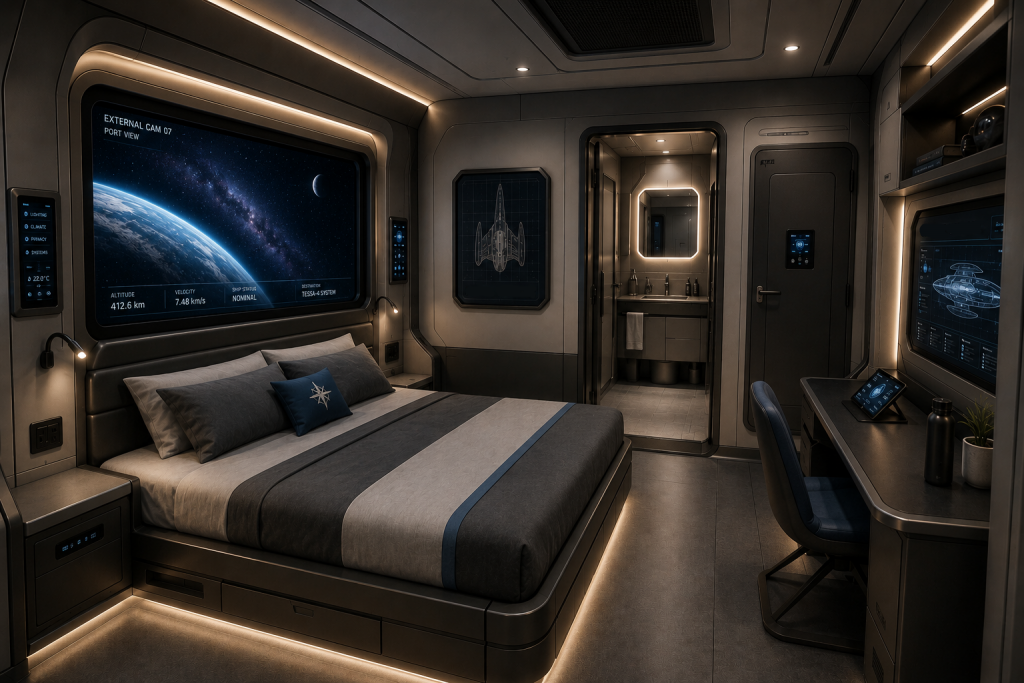
Cabin Philosophy
Cabins are designed to feel believable, functional, and immersive rather than extravagant. The design goal is to create the sensation of living aboard a real interstellar spacecraft.
Features include:
- Intelligent lighting
- Environmental control
- Interactive displays
- Simulated exterior viewscreens
- Integrated mission communications
- Comfortable sleeping accommodations
- Compact spacecraft-inspired layouts
- Acoustic isolation
- Private bathrooms and showers
- Durable operational finishes
Unlike a high-end hotel, the environment should feel:
- Functional
- Realistic
- Comfortable
- Technically sophisticated
- Operationally believable
Operating Philosophy
The operation intentionally minimizes visible staffing in order to preserve immersion. Guests should feel they are serving aboard a functioning vessel rather than staying at a upscale hotel. The operational model emphasizes:
- Crew autonomy
- Mission participation
- Environmental realism
- Hidden support infrastructure
- Efficient staffing
- High immersion continuity
Visible operational staff primarily include:
- Mission actors
- Ship officers
- Technical operators
- One steward
- Culinary staff
Back-of-house support remains concealed through hidden service corridors and operational access spaces.
Food and Beverage
A Scout Class vessel has approximately 14 guests, one Culinary Officer, and one Chief Steward. They are on multi-day missions and the ship has limited galley space. The commissary-supported galley concept is operationally superior to a traditional restaurant kitchen. It reduces staffing, reduces inventory, improves food consistency across six ships, and allows you to deliver gourmet-quality meals while keeping the onboard crew limited to a Culinary Officer and Steward. Most importantly, it supports the central goal: the mission remains the focus, while the dining experience enhances it rather than dominating it.
Dining Experience
Food quality is intentionally high and professionally prepared. Meals are integrated into the immersive experience rather than presented as premium hospitality.
The galley and dining commons are designed to reinforce:
- Crew interaction
- Mission discussion
- Team bonding
- Operational atmosphere
- Long-duration voyage realism
Preparing every meal completely from scratch creates several problems:
- Large food inventories
- Large refrigeration requirements
- Significant waste
- Increased staffing requirements
- Reduced crew interaction
A commissary model solves all of these. The Hospitality Center should contain a commercial production kitchen. This becomes the food service hub for the entire fleet.
For six active ships:
- Breakfast production
- Lunch production
- Dinner production
- Desserts
- Snacks
- Beverages
All prepared centrally. This is exactly how deluxe resorts, cruise ships, airlines, and private aviation caterers often operate.
Shipboard Galley
The galley becomes a finishing kitchen rather than a production kitchen. The Culinary Officer performs final preparation, plating, garnishing, heating, and assembly. Guests still receive gourmet-quality meals. The difference is that much of the labor occurred earlier.
Hidden Galley Supply Access
The galley should contain a hidden commissary hatch accessible only from the service corridor. Mission staff can quietly deliver meals, ingredients, ice, desserts, and fresh snacks without entering guest spaces.
This provides enormous flexibility. Mission Control could even adjust food service dynamically. For example, if a mission unexpectedly extends, additional meals can be delivered. The crew never knows.
Inventory Philosophy
The ship should carry only daily use inventory such as coffee, tea, soft drinks, water, condiments, snack foods, fruit, and ice. The ship does not need four days of raw meat, bulk vegetables, and large frozen inventories. The commissary already exists.
Meal Selection Process
Selecting meals during mission registration mirrors luxury yacht operations. A pre-mission Culinary Profile allows Guests to indicate:
Dietary Restrictions
- Vegetarian
- Vegan
- Gluten Free
- Kosher
- Halal
- Allergies
Preferences
- Beef
- Seafood
- Poultry
- Vegetarian
- Beverage Preferences
- Coffee
- Tea
- Soft drinks
The Culinary Officer receives the manifest, and the commissary produces the appropriate menu package.
Shared Menu Concept
The crew should eat the same meal; not twenty different restaurant orders. The benefits are crew cohesion, shared dining experience, operational Simplicity, much easier service, and the premium yacht feel. This is how many private charter experiences operate. Shared meals enhance the immersion making the experience feel like a real ship.
Dining Philosophy
Meals should be events, not merely food.
| Breakfast | Simple but high quality. | Omelets Fresh pastries Fruit Specialty coffee |
| Lunch | Mission-oriented. Quick but substantial. | Gourmet sandwiches Soups Salads Hot entrées |
| Dinner | The centerpiece meal where the Crew gathers. Mission stories are exchanged. Decisions discussed. The social experience becomes as important as the food. | |
| Self-Service Bar | This is essential, not because of alcohol, because people expect a gathering place. The bar should function as a Crew Lounge. The bar should be open 24 hours a day. | Soft drinks Coffee Tea Sparkling water Snacks |
Alcohol Policy
If alcohol is offered, it should be limited. After all, guests are operating the ship. During active mission periods there should be no alcohol or very limited alcohol. At end-of-shift the steward opens bar service. This creates a natural transition from duty time to off-duty time. The bar includes:
- Wine
- Beer
- Cocktails
- Mocktails
Steward’s Role
The steward becomes much more important than many people realize. The steward is effectively the hotel manager, bartender, concierge, and morale officer. The steward’s primary responsibility is guest experience.
The chef focuses on dining. The steward focuses on people.
Crew Adjustment
The Psychological Objective
By the time guests enter the ship they have already invested a day of training, so their first 24 hours aboard the vessel is not about training. It is about transformation. When guests arrive, they are just beginning their transfer from accountants, software engineers, teacher, retirees, or students. By the end of the first day, they should think of themselves in their crew roles. That identity shift is critical. Without it, the mission feels like a game. With it, the mission feels real.
Upon arrival at the Starship, especially for first time guests, the mission should not start immediately. The ships Steward escorts crew to their cabins. Guests unpack, storing belongings and exploring the cabin systems. They experiment with displays, adjust lighting,
read mission materials.
For many guests this is the first moment they can quietly absorb they are actually living on a starship. This should not be rushed.
Ship Familiarization Period
The crew is given approximately one hour of free time. Guests naturally begin exploring all the decks of the starship; the Bridge, Science Lab, Engineering, and so on. No major events occur. No emergencies. No puzzles. No aliens. The ship simply exists. This is important because it establishes normality. Later emergencies have meaning because guests understand what “normal” looks like.
SCOUT is arguably one of the most important characters in the experience. This time allows crew members to interact with SCOUT, learning it is more than the ship’s computer; it is an assistant, mission facilitator, training system, mission narrator, and companion.
Informal Crew Gathering
The Steward hosts an informal social gathering in the Crew Lounge. Snacks, coffee, cocktails, and mocktails are served. The objective is simple, people talk, the future Captain begins interacting with the crew. Engineers find engineers. Scientists find scientists. Friendships begin. This social bonding is enormously important.
Captain’s Welcome Dinner
The first dinner should feel ceremonial. Not luxurious. Significant. The Captain addresses the assembled crew reviewing the mission, crew expectations, the ship philosophy, and department introductions. The meal becomes the crew’s first official gathering. By the end of dinner everyone knows the Captain, department heads, who they will work with, and evening operations.
After dinner the mission still does not begin. Instead, there are department meetings where each department gathers independently. These meetings should be short. The purpose is crew bonding.
| Engineering | Review systems Meet department members |
| Science | Review mission equipment Discuss objectives |
| Command | Review operational procedures |
Afterwards there are optional ship activities where guests are free to visit the lounge, play shipboard games, explore databases, study star charts, review mission packets, and socialize. This is when immersion deepens because nobody is forcing it.
Night Cycle
The ship transitions to night mode. Lighting changes. Background sounds shift. SCOUT announces:
Ship time 2200 hours. Departure operations scheduled for 0800 tomorrow.
Guests retire to cabins. This is the moment many guests will realize they are actually sleeping aboard a starship. That is surprisingly powerful.
Day 2 through Day 4 – Mission
After breakfast the Captain holds a crew briefing. The mission begins:
- Departure checklist.
- Department readiness reports.
- Bridge stations manned.
- Engineering online.
- Navigation plotting course.
- SCOUT announces:
- All departments report ready.
- Mission authorization granted.
- Scout Vessel Horizon departing orbital station.
Now the adventure starts.
Why This Matters
From an operational perspective, delaying the mission by one evening may seem inefficient. From a guest-experience perspective, it is invaluable. The first evening accomplishes several things:
| Objective | Result |
| Guests learn ship layout | Less confusion later |
| Guests personalize cabins | Increased ownership |
| Crew members meet naturally | Better teamwork |
| Social hierarchy develops | Stronger leadership |
| Ship feels real | Better immersion |
| Anticipation builds | Stronger emotional payoff |
Most importantly, the ship becomes home before it becomes a workplace. That single change dramatically increases emotional attachment to the vessel, the crew, and the mission. When the mission finally ends several days later, guests are not merely leaving an attraction. They are leaving a place they lived. That emotional attachment is exactly what drives repeat bookings and long-term community formation.
Mission Types
Exploration Missions
| Uncharted System Survey | Map planets Analyze atmosphere Search for life Deploy probes | Challenges: Sensor anomaliesNavigation hazardsResource managementDeep Space PhenomenonObjectives:Investigate strange readingsDetermine scientific causeReturn data |
| Deep Space Phenomenon | Investigate strange readings Determine scientific cause Return data | Possible discoveries: NebulaBlack holeAncient beaconSubspace anomaly |
Rescue Missions
| Missing Survey Vessel | Locate lost ship Recovering survivors Determine cause | Possible complications: Reactor damageAlien interferenceCrew mutinyEnvironmental hazards |
| Colony Distress Call | Deliver aid Restore power Evacuate casualties | Complications: Disease outbreakMeteor impactPirate activity |
Diplomatic Missions
| First Contact | Establish communication Avoid conflict Negotiate agreement | Mission Control can provide: Language puzzlesCultural misunderstandingsEthical dilemmas |
| Treaty Negotiation | Resolve dispute Preventing war Reach compromise | Success depends on communication skills rather than technology. |
Engineering Missions
These will likely be extremely popular.
| Prototype Drive Evaluation | Test new propulsion technology Monitor performance Solve failures | Mission Control can introduce: Cooling failuresPower instabilitySensor conflicts |
| Reactor Emergency | Stabilize reactor Protect crew Complete mission | Engineering becomes the hero department. |
Scientific Missions
| Archaeological Expedition | Investigate alien ruins Translate symbols Recover artifacts | Complications: TrapsEnvironmental hazardsCompeting factions |
| Biological Survey | Study life forms Analyze samples Preventing contamination |
Drone Surveillance Missions
The crew deploys one or more autonomous reconnaissance drones equipped with sensors, communications equipment, imaging systems, and environmental monitoring instruments.
The drones extend the ship’s awareness beyond normal sensor range and allow the crew to investigate hazards without risking the starship.
Mission success depends upon gathering useful intelligence while protecting the drones from environmental and operational threats.
Day 5 – Mission Conclusion
Captain’s Dinner
Once on the last evening of each mission. The entire crew gathers. Formal uniform dress is encouraged. The menu is special. The Captain reviews the mission’s progress. Photos are taken and toasts made. Perhaps awards are presented. Years later, guests will remember that dinner as one of the defining moments of their voyage.
Mission Complete
The morning of the Mission’s last day, the ship returns and docks with the Orbital Transfer Sleeve. After breakfast, the Captain may call for a final debrief aboard ship with just the crew members.
SCOUT announces, “Mission complete. Prepare for transfer.”
The crew packs, leaves cabin, and moves to the ship’s airlock, and transfers back to OTV through the Orbital Transfer Sleeve. Once the crew boards the transport and is seated, the starship slowly disappears from view intended to create a surprisingly emotional moment. People become attached to the vessel.
During orbital reentry displays show the Earth growing larger as they begin their decent. During atmospheric entry, descending through the clouds, the motion platform provides a light vibration to simulate atmospheric buffeting. The Orbital Crew Transport Vehicle (OTV) lands and taxis back to the transport docks in Mission Control. The hatch door opens and the crew returns to Earth.
The transport system accomplishes three objectives:
1. Creates Separation – Guests mentally leave the real world.
2. Creates Anticipation – Excitement builds before boarding.
3. Creates Closure – The return trip allows guests to process the mission.
When they arrive, their belonging are returned and they change into their civilian cloths before the Mission Debrief. This give them a sense they are home and a reminder that each of their crewmembers has their own personal identity.
Mission Outcome Framework
The mission outcome should not feel like a video game score screen. It should feel like the conclusion of a real starship deployment. Guests have spent days living aboard a starship. They have formed friendships, solved problems, argued over decisions, and developed a crew identity. A debrief should provide emotional closure and celebrate what they accomplished.
Mission Debrief Philosophy
The objective is not to tell guests, “You scored 87%.” The objective is to tell them: “This is what you and your crew achieved.” The emphasis should be on narrative accomplishments rather than numerical scores.
Mission Completion Ceremony
At mission conclusion the crew returns to Mission Control where the final event should be. This should take the form of a Command Debrief held in a briefing room. A large display presents:
- Mission Summary
- Mission Name
- Mission Duration
- Assigned Vessel
- Crew Manifest
- Captain
- Executive Officer
- Department Heads
- Mission Outcome
The mission outcome would be one of five possibilities.
| Distinguished Success | Primary objectives completed. Secondary objectives completed. Crew losses minimal. Exceptional discoveries made. Unexpected opportunities exploited. Mission exceeds expectations. |
| Mission Success | Primary objectives completed. Most secondary objectives completed. Crew operated effectively. |
| Qualified Success | Primary objectives completed. Significant mistakes occurred. Resources heavily depleted. Crew survived and returned. |
| Mission Failure | Primary objectives not completed. Major opportunities missed. Ship returned safely. |
| Catastrophic Failure | Mission abandoned. Ship critically damaged. Crew survival became primary objective. Ironically these may become the most memorable missions. |
Department Performance Analysis
Mission Control should evaluate departments rather than individuals. Avoid embarrassing guests. Instead evaluate:
| Command | Leadership Decision making Crisis management Crew coordination |
| Navigation | Route efficiency Hazard avoidance Mission timing |
| Engineering | Power management Resource allocation Emergency response |
| Science | Data collection Investigation quality Discovery rate |
| Medical | Casualty treatment Response time Crew wellness Crew Personality Analysis |
| Communications | Diplomatic effectiveness Intelligence gathering Information management |
Crew Personality Analysis
SCOUT generates a Crew Profile.
For example:
SSA Sunset Crew
| Crew Style: | Scientific Explorers |
| Characteristics: | High curiosity |
| Moderate risk tolerance | |
| Strong teamwork | |
| Excellent crisis response | |
| Comparison: | Similar to 12% of previous crews. |
Guests love this kind of analysis. This may become one of the most popular parts.
Mission Log Highlight Reel
Mission Control should automatically generate. For example:
| Star Date | Event |
| 0800 | Departed Sol System |
| 0945 | Detected Unknown Signal |
| 1030 | First Contact Established |
| 1315 | Reactor Casualty |
| 1440 | Ancient Structure Discovered |
| 1700 | Mission Completed |
Guests immediately relive their adventure.
Crew Awards
This is where memories become tangible. Not everyone needs an award. But each guest should receive something personalized.
Some Examples:
- Captain’s Commendation
- Outstanding Leadership
- Engineering Excellence Citation
- Exceptional Technical Performance
- Explorer’s Citation
- Scientific Discovery
- Diplomatic Service Medal
- Conflict Resolution
- Distinguished Service Award
- Outstanding Contribution
The Memento Package
Every guest receives a:
- Mission Certificate printed on premium stock and should resemble an official service record. It should contain:
- Crew member name
- Ship name
- Mission name
- Position held
- Mission outcome
- Captain signature
- Mission Director signature
- Embroidered Mission Patch. Guests collect these over time. This encourages repeat visits.
- Crew Photograph taken in uniform on the bridge before departure presented in a frame. Guests will display these for years.
- Personalized Service Record (essentially a Starship Adventures career record) containing:
- Missions completed
- Roles served
- Awards earned
- Discoveries made
- Military challenge-coin style Mission Coin where the Front contains the Ship emblem and the back has the mission name, date, and outcome
These are inexpensive to produce but feel extremely valuable.
Long-Term Career Progression
This is where repeat business becomes powerful. Imagine a guest returns five times. Mission Control recognizes the guest’s previous missions, their crew positions and makes promotion recommendations. Now the guest feels they are building a career, not purchasing another vacation.
Conclusion
The Guest Crew Experience defines the core product of Starship Adventures and illustrates how the organization transforms visitors into active participants in an interstellar adventure. Rather than observing a story, guests become responsible for its outcome. They assume roles, solve problems, make decisions, build relationships, and experience the challenges of operating a starship as a functioning crew.
This approach fundamentally differentiates Starship Adventures from traditional hospitality, themed entertainment, simulation attractions, and cruise experiences. The objective is not to transport guests through a scripted sequence of events, but to create an environment where every mission becomes a unique story shaped by the actions of the crew itself.
The experience is intentionally designed to encourage repeat participation. Through career progression, mission records, campaign continuity, awards, certifications, and evolving responsibilities, guests develop a personal connection to both their vessel and the larger Starship Adventures universe. Over time, individual voyages become part of an ongoing journey in which returning guests build reputations, form crews, pursue command opportunities, and participate in a shared history that continues to evolve long after a mission concludes.
As the guest community grows, Starship Adventures transitions from a destination attraction into a living organization with its own culture, traditions, and loyal membership. This transformation creates a powerful competitive advantage by combining premium experiential travel, immersive storytelling, simulation gaming, and community participation into a product category that does not currently exist elsewhere in the market.
Starship Adventures Campus demonstrates how this experience is operationally delivered. It describes the facilities, infrastructure, logistics, support systems, and organizational framework required to simultaneously operate multiple starships while maintaining the immersion, scalability, and service standards necessary to support long-term growth.