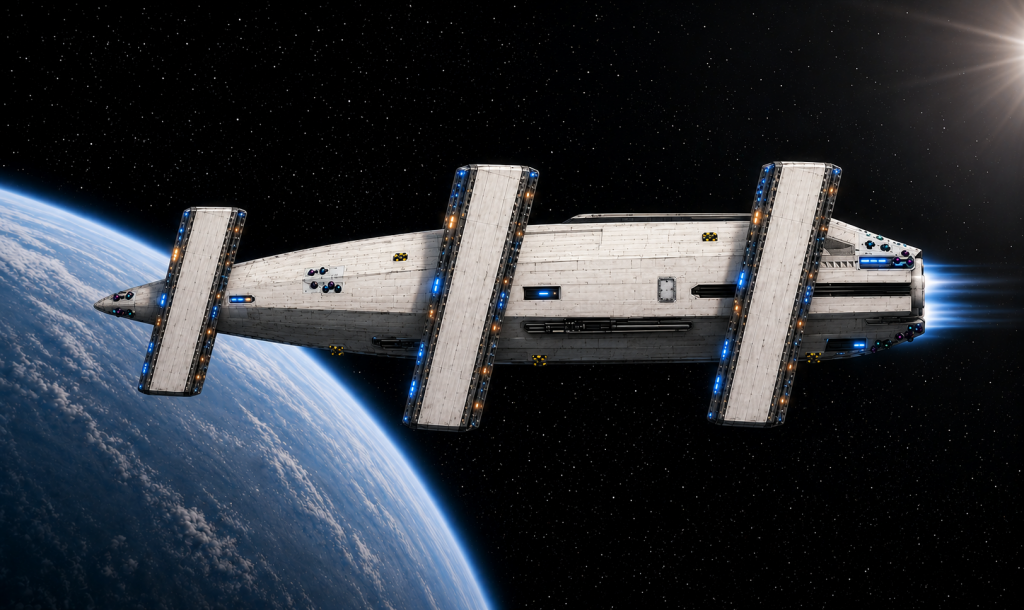
Starship Adventures is a destination-based immersive entertainment enterprise that allows guests to live aboard a fully realized interstellar starship and participate in multi-day space exploration missions as active crew members.
Overview
Unlike traditional attractions that focus on passive observation, Starship Adventures places guests at the center of the experience. Guests do not watch a story unfold. They become part of it. Every guest receives a role, responsibilities, access privileges, and operational duties aboard a functioning starship environment. Mission success depends upon the decisions, leadership, teamwork, and problem-solving abilities of the crew itself.
The experience combines elements of science fiction, simulation gaming, live-action role playing, experiential tourism, hospitality, and team-based adventure into a single integrated product that currently has no direct large-scale competitor.
The company’s initial campus is designed to support six simultaneous Scout Class starships operating independently from a shared Mission Control and support infrastructure. Each vessel hosts a crew of guests who live aboard during extended missions involving exploration, scientific discovery, diplomacy, emergency response, resource management, and other dynamically evolving scenarios.
The Starship Adventures business model is intentionally built around deep immersion rather than high-volume attendance. Limited crew capacity, premium pricing, high repeatability, private charter opportunities, and evolving campaign-style missions create a recurring customer base with unusually strong community engagement. Over time, guests progress from first-time participants to experienced crew members who return for increasingly complex missions, creating a self-sustaining ecosystem of enthusiasts, clubs, charter groups, and recurring customers.
Supporting the experience is a comprehensive operational infrastructure including a dedicated Mission Control complex, training facilities, hospitality accommodations, simulation systems, and a fleet of full-scale starship environments. The Scout Class Starship specification demonstrates the depth of world-building and technical realism employed to create a believable and emotionally compelling experience that guests perceive as authentic.
Starship Adventures occupies a unique position between destination tourism, simulation gaming, experiential entertainment, and science fiction fandom. The result is a scalable enterprise capable of generating recurring revenue through mission bookings, private charters, memberships, merchandise, special events, and future fleet expansion.
Starship Adventures is not competing with cruise ships, theme parks, escape rooms, or hotels.
Starship Adventures objective is to create a new category of destination-based immersive adventure entertainment where guests live as crew members aboard a simulated starship during multi-day missions.
The experience combines:
- Full-scale starship Environment
- Operational bridge simulators
- Interactive mission systems
- Live performers and mission staff
- Dynamic branching narratives
- Environmental simulation effects
- Practical spacecraft operations
- Comfortable expedition-style accommodations
- Gourmet dining integrated into the in-universe setting
The attraction is specifically designed for:
- Dedicated science fiction enthusiasts
- Fandom tourism markets
- Simulation and gaming communities
- Interactive adventure travelers
- Corporate team-building groups
- Convention audiences
- Guests seeking transformational experiences rather than passive entertainment
The business model intentionally prioritizes:
- Deep immersion over mass throughput
- Operational realism over theatrical spectacle
- Limited occupancy over crowd volume
- Repeat mission variability over static attractions
- Emotional engagement over luxury hospitality
- Guests temporarily leave Earth behind and function as crew members aboard a believable interstellar vessel operating “light years from Earth.”
- The project occupies a unique market position between:
- Destination experiential tourism
- Advanced simulation environments
- Multi-day immersive roleplay
- Interactive storytelling
- Boutique themed hospitality
- Expedition-style adventure travel
Starship Adventures is not a theme park ride. It is a live operational science fiction experience.
This document will provide potential investors, lenders, strategic partners, and financial analysts with a structured evaluation of the capital requirements, operating assumptions, revenue drivers, and potential investment outcomes associated with the project.
Vision Statement
To create the world’s most believable operational starship experience where guests temporarily leave Earth behind and live as crew aboard a functioning interstellar vessel.
Mission Statement
To deliver authentic science fiction immersion through realistic starship operations, collaborative mission-based storytelling, advanced simulation technology, and highly believable environmental design.
This document, Volume 2 – Investor Prospectus, describes the Starship Adventures Concept, Market Opportunity, a Competitive Analysis, a Revenue Model, Financial Projections, a Development Roadmap, Investment Opportunities, and a Risk Mitigation analysis.
Companion Documents
| Companion Document | Purpose |
| Volume 1 – Feasibility Study | Evaluates whether the concept can be developed, financed, constructed, operated, and scaled as a commercially viable destination-based immersive entertainment enterprise. |
| Volume 2 – Investor Prospectus | This document. |
| Volume 3 – Guest Crew Experience | Describes the customer journey, crew-role structure, mission participation model, onboard life, and repeat-guest engagement strategy. |
| Volume 4 – Starship Adventures Campus | Describes the physical campus, Mission Control, training center, hospitality infrastructure, assembly facility, simulation systems, and operational support model. |
| Volume 5 – Scout Class Starship Design Specification | Provides the technical and experiential design foundation for the starship environment. |
| Volume 6 – Financial Model and Capital Analysis | Provides potential investors, lenders, strategic partners, and financial analysts with a structured evaluation of the capital requirements, operating assumptions, revenue drivers, and potential investment outcomes associated with the project. |
Starship Adventures Concept
Guests board a fully realized interstellar vessel and assume operational roles including:
- Command
- Helm
- Navigation
- Engineering
- Science
- Communications
- Security
- Medical
- Tactical Operations
- Remote Drone Operations
Every guest participates directly in the mission. Mission outcomes evolve dynamically based on crew decisions, system performance, teamwork, and operational success. Mission scenarios may include:
- First contact diplomacy
- Distress rescues
- Reactor emergencies
- Tactical engagements
- Scientific anomalies
- Espionage scenarios
- Navigation hazards
- System failures
- Alien archaeology
- Resource shortages
- Boarding threats
- Exploration operations
The objective is not simply entertainment. The objective is to create the psychological sensation of serving aboard a functioning starship.
Market Opportunity
The Growth of Experiential Entertainment
Consumer demand continues shifting away from passive entertainment and toward:
- Interactive experiences
- Emotional engagement
- Social participation
- Personalized adventures
- Transformational travel
- Shareable memories
- Community-driven entertainment
Audiences increasingly seek experiences that allow them to temporarily inhabit alternate realities rather than simply observe them.
Science Fiction Fandom Economics
Science fiction fandom represents one of the most durable and financially committed entertainment communities in the world.
Examples include:
- Comic-Con tourism
- Destination fan conventions
- Bridge simulator communities
- Immersive gaming ecosystems
- Live-action roleplay (LARP)
- Streaming franchise fandoms
- Sci-fi cruise events
- Collectible and cosplay industries
More than 135,000 highly engaged science-fiction and fantasy enthusiasts already travel to San Diego every year and collectively generate over $160 million in economic activity. This demonstrates the existence of a large and affluent customer base willing to spend significant sums on immersive genre entertainment experiences. Starship Adventures is positioned to capture a small but premium segment of this market by offering an experience unavailable anywhere else in the world.
Comic-Con demonstrates there is already a large population willing to:
- Travel internationally
- Spend thousands on a hobby.
- Wait years for tickets.
- Dress in costume
- Participate in fictional worlds.
- Attend repeatedly.
This is essentially the same customer psychology Starship Adventures is targeting.
How does it compare?
Comic-Con attendee:
- Pays for airfare.
- Pays for hotels.
- Pays for badge.
- Pays for merchandise.
- Pays for food.
- Pays for dedicated events.
A serious attendee can easily spend:
- $1,500–$4,000 for a convention trip
- More for VIP experiences
The difference is that Comic-Con is only a few days and it is largely observational.
The Starship Adventures audience is:
- Highly engaged
- Technically literate
- Community-oriented
- Experience-driven
- Passionate about authenticity
- Willing to travel internationally
- Highly likely to return for repeat experiences
Compared to a traditional convention, Starship Adventures would be:
- Participatory
- Multi-day
- Limited capacity
- Highly immersive
- Premium-priced
That places it closer to:
- Luxury expedition travel
- Live-action role-playing events
- Adventure tourism
- Private yacht charters
An Interesting Perspective
Suppose Starship Adventures operated six Scout Class vessels:
14 guests per ship
6 ships
84 guests per mission
Five-day missions (68 per vessel per year)
50 operating weeks per year
That yields roughly 5,712 guest slots annually.
Compared to Comic-Con’s 135,000 attendees, only about 4.0% of the annual Comic-Con audience would need to be attracted to fill every available berth for an entire year.
That is a powerful statistic for investors because it demonstrates that the business does not need mass-market appeal to be successful. It only needs a small fraction of an already proven enthusiast market.
Premium Expedition Travel Is the Closest Analog
While not an accurate comparison, most people initially categorize Starship Adventures as an event similar to:
- Cruise ships
- Theme parks
- Escape rooms
- Live Action Role Play (LARP) events
The real comparison is:
- Antarctic expeditions
- Arctic expeditions
- Galapagos expeditions
- Luxury safari lodges
- Private yacht expeditions
- Adventure tourism
People buying these products are not purchasing transportation. They are purchasing:
- Exploration
- Discovery
- Exclusivity
- Storytelling
- Personal transformation
- Social status
This is exactly what Starship Adventures sells.
Market Comparison
| Category | Premium Expedition Cruise | Starship Adventures |
| Transportation | Real ship | Simulated starship |
| Duration | 7–21 days | 5–14 days |
| Accommodations | Comfortable | Comfortable |
| Dining | Gourmet | Gourmet |
| Crew Service | High | Moderate |
| Exploration | Real destinations | Simulated destinations |
| Participation | Mostly passive | Highly active |
| Problem Solving | Minimal | Core activity |
| Social Interaction | Moderate | Essential |
| Repeatability | Moderate | Extremely high |
| Unique Story | Limited | Every mission unique |
This table reveals something important. Luxury expeditions are mostly observational. Starship Adventures is participatory. Guests become part of the experience.
Pricing Comparison
Current expedition pricing:
| Experience | Typical Price |
| Arctic 8 days | $20,000–$30,000 |
| Antarctica 10–14 days | $15,000–$40,000 |
| Greenland 15 days | $25,000–$50,000 |
| Luxury African Safari | $12,000–$30,000 |
| Private Yacht Expedition | $15,000–$100,000+ |
The buyers of these products already exist. The question for investors becomes: Would some of these people pay similar amounts to spend a week living aboard a believable starship? We believe the answer is yes.
Where Starship Adventures Is Actually Better
This may sound counterintuitive, but luxury expeditions have a major weakness. After the trip, the customer has photographs, maybe some souvenirs, and a few stories. Then it is over.
Starship Adventures creates something much more valuable: Identity. Guests become Captains, Engineers, Scientists, Diplomats, and Explorers. They develop reputations, rank, career progression, and crew relationships. This is why the repeat-customer model is potentially much stronger than expedition cruising. An Antarctic traveler may go once. A Starship Adventures Captain may return every year for a decade.
Customer Demographics
Luxury expedition travelers tend to be:
- Age 35–75
- High income
- Well educated
- Curious
- Technology friendly
- International travelers
Those demographics overlap remarkably well with:
- Science fiction fans
- Comic-Con attendees
- Aerospace enthusiasts
- Engineers
- IT professionals
- Scientists
- Military veterans
In many ways, Starship Adventures is simply replacing: “I climbed aboard an expedition ship and explored Antarctica.” With “I commanded a starship and made first contact with an alien civilization.” Both satisfy the same emotional need of exploration, adventure, achievement, and discovery.
The Major Competitive Advantage
Luxury expedition travel is limited by geography. There is only one Antarctica. There is only one Galapagos. There are only so many safari lodges. Starship Adventures can create:
- Thousands of star systems
- Hundreds of missions
- Infinite anomalies
- Endless campaigns
A customer can return repeatedly and never have the same experience twice. That is an advantage expedition operators do not have.
What This Means for Investors
Starship Adventures is “The world’s first premium immersive science-fiction expedition experience.” It is not a themed attraction. Not a role-playing game. Not an escape room. It is not even a luxury hotel.
Instead, Starship Adventures is a premium expedition experience where guests live aboard a functioning starship, serve as its crew, and undertake multi-day missions of exploration, diplomacy, rescue, and discovery.”
That positioning places Starship Adventures in a market where customers are already accustomed to spending $10,000–$30,000+ per person for a once-in-a-lifetime adventure. It also explains why the concept may ultimately generate higher repeat visitation than most luxury expedition operators: the destination is not Antarctica—it is the ongoing career and story of the crew itself.
Luxury Yacht Charters
This comparison is even more compelling than the expedition market because luxury yacht charters already demonstrate that affluent customers will pay exceptionally large sums for a private, immersive, social experience that is as much about the people as the destination.
In many respects, Starship Adventures resembles a luxury yacht charter more than any other existing business.
The Core Similarity
When someone charters a yacht, they are not primarily paying for transportation. They are paying for:
- Exclusivity
- Privacy
- Group experience
- Personalized adventure
- Prestige
- Shared memories
The yacht itself becomes the destination. The same is true of Starship Adventures. The starship is not transportation. The starship is the experience.
Side-by-Side Comparison
| Category | Luxury Yacht Charter | Starship Adventures |
| Primary Asset | Yacht | Starship |
| Guest Capacity | 8–20 guests | 14 guests |
| Duration | 5–14 days | 5–14 days |
| Private Cabins | Yes | Yes |
| Gourmet Dining | Yes | Yes |
| Crew Service | High | Moderate |
| Shared Social Experience | Yes | Yes |
| Exclusive Environment | Yes | Yes |
| Adventure Component | Moderate | Very High |
| Active Participation | Low | Very High |
| Story Development | None | Continuous |
| Repeatability | Moderate | Extremely High |
The most important difference is that Yacht guests are passengers where Starship guests are crew.
Pricing Comparison
Examining actual market pricing.
Small Luxury Charter
8–12 guests
$50,000–$150,000 per week
Mid-Range Luxury Charter
12–16 guests
$150,000–$300,000 per week
Premium Expedition Yacht
12–20 guests
$250,000–$1,000,000+ per week
When divided by occupancy, it is common to see:
Per Guest is $8,000–$25,000+ per week before airfare.
These are real-world prices already accepted by the market.
An Interesting Observation
A yacht owner must continuously pay for:
- Fuel
- Dockage
- Crew
- Maintenance
- Insurance
- Ocean operations
Starship Adventures avoids many of those costs. There are still costs for:
- Facilities
- Staff
- Hospitality
- Maintenance
But Starship Adventures does not have the recurring Yacht fees or issues:
- Maritime operations
- Port fees
- Marine fuel
- Coast Guard compliance
- Ocean weather disruptions
This means operating costs may be significantly lower than comparable yacht experiences while charging similar premium pricing.
Where Starship Adventures Exceeds a Yacht
A yacht offers luxury. A starship offers purpose. Consider two guests.
Yacht Guest
Day 1:
- Eat dinner
- Sightsee
- Drink wine
Day 5:
- Eat dinner
- Sightsee
- Drink wine
Very pleasant.
But largely passive.
Starship Guest
Day 1:
- Assigned as Chief Engineer
- Learn ship systems
- Meet crew
Day 5:
- Reactor casualty
- Alien artifact discovery
- Diplomatic crisis
- Emergency rescue mission
The guest becomes part of the story. That is far more emotionally engaging.
Community Formation
This is where Starship Adventures gains a major advantage. A yacht charter is usually:
One trip.
One group.
One memory.
Starship Adventures can become:
Multiple missions.
Recurring crews.
Advancing careers.
Campaign storylines.
Returning captains.
Returning engineers.
Returning science teams.
Over time guests begin identifying themselves as members of the organization. That creates an ecosystem similar to Sailing clubs, Flying clubs, and Yacht clubs, except built around starships.
Investor Perspective
Starship Adventures combines the accommodations, exclusivity, and premium pricing characteristics of the luxury yacht charter market with the engagement, replayability, and community-building characteristics of immersive role-playing and simulation experiences. That is an unusual combination.
Luxury charters typically generate high revenue per guest but limited repeat visitation.
Gaming and fandom communities generate exceptional repeat visitation but lower revenue per customer.
Starship Adventures has the potential to achieve both.
The Most Powerful Comparison
Suppose a 14-passenger Starship Adventures mission is priced at: $12,500 per guest.
Revenue per mission: 14 × $12,500 = $175,000
That is already within the range of many luxury yacht charters. Yet from the guest’s perspective they receive:
- Private cabin
- Gourmet meals
- Exclusive access
- Small-group experience
- Adventure
- Problem-solving
- Leadership opportunities
- Personalized story
In other words, a luxury yacht sells the fantasy of being a guest aboard an extraordinary vessel. Starship Adventures sells the fantasy of being responsible for one. That distinction is likely to resonate strongly with the affluent science-fiction enthusiast demographic at the core of the target market.
Current Industry Gap
Most remaining existing offerings fall into two categories:
Theme Park Attractions
High-throughput experiences designed for short-duration entertainment.
Escape Rooms and Simulators
Limited in scale, realism, persistence, and emotional immersion. No major offering currently combines:
- Multi-day immersion
- Realistic starship operations
- Full-scale spacecraft environments
- Persistent mission systems
- Collaborative crew gameplay
- Dynamic story progression
- Overnight onboard accommodation
- Operational simulation complexity
Starship Adventures fills this gap.
Target Customers
Demographics
- Ages 25–65
- Science fiction enthusiasts
- Convention attendees
- Technology professionals
- Gamers
- Engineers
- Simulation hobbyists
- LARP communities
- Interactive storytelling audiences
- Corporate leadership groups
Guest Psychology
The attraction appeals to guests who want:
- To temporarily live another life
- To experience realistic starship operations
- To participate in meaningful missions
- To solve problems collaboratively
- To feel emotionally immersed
- To experience adventure and discovery
- To belong to a crew
Secondary Markets
- The Experience Economy: Consumers are shifting spending from material goods to deeply emotional, shareable, and memorable life events.
- Hyper-Personalization: The demand for bespoke, private travel is at an all-time high, with guests seeking to escape mass-market tourism in favor of total isolation and exclusivity.
- Gamified Hospitality: Blending traditional high-touch hospitality (like a personal butler and gourmet dining) with interactive theater creates an escapist environment that cannot be replicated by screens.
- Corporate Team Building: Simulation-based leadership and collaboration experiences.
- Influencers / Media: Premium viral experiential content opportunities.
- Private Buyouts: Exclusive charter-style events.
- International Tourism: Destination fandom travel.
Competitive Advantages
Authentic Operational Immersion
The project prioritizes realism and operational believability over spectacle.
Guests function as active crew members rather than passive customers.
Repeatability
Mission structures vary significantly between voyages.
Returning guests can experience:
- Different story arcs
- New crew dynamics
- Different ship emergencies
- Evolving mission systems
- Alternate mission outcomes
- Seasonal campaigns
High Emotional Investment
Unlike passive entertainment, guests become participants whose decisions affect outcomes.
This creates:
- Strong word-of-mouth
- Community formation
- Repeat participation
- Long-term fandom ecosystems
- Social media amplification
- High retention rates
- Customer Loyalty
Minimal Direct Competition
No current competitor combines:
- Multi-day immersion
- Full-scale starship Environment
- Operational bridge simulation
- Overnight accommodation
- Persistent crew interaction
- Dynamic mission systems
- Realistic spacecraft operations
at comparable scale.
Development Roadmap
| Phase 1 — Prototype & Validation | Operational demo environmentInvestor demonstrationsConvention showcasesMission software frameworkConcept renders Prototype bridge simulator Brand development |
| Phase 2 — Engineering & Facility Acquisition | Facility acquisition Structural engineering Simulation infrastructure planningTechnology architecture |
| Phase 3 — Construction | Hull fabrication Deck constructionSystems installationEnvironmental integration Hidden operational infrastructure |
| Phase 4 — Technology Integration | Mission Systems AI systems Console integrationEnvironmental automationAudio and lighting systems |
| Phase 5 — Staffing & Training | Performer trainingMission operations developmentTechnical operations trainingEmergency proceduresGuest immersion protocols |
| Phase 6 – Closed Beta Voyages | Invite-only operationsOperational stress testingMission balancingGuest feedback analysis |
| Phase 7 – Public Launch | Full operationsMembership programsConvention partnershipsCorporate voyage sales |
Investment Opportunities
A single six-ship campus can be a profitable business. Multiple campuses can become a major entertainment brand. The key is understanding what scales well and what does not.
Phase 1-Establish the Flagship Campus
The first facility should be viewed as a proof-of-concept rather than the final business.
Objectives
- Validate guest demand
- Validate pricing
- Build operating procedures
- Build mission content library
- Build brand recognition
- Build guest community
- Demonstrate profitability
The first campus would likely include:
- 6 Scout Class Starships
- Mission Control
- Training Center
- Hospitality Infrastructure
- Commissary
- Administration
- Maintenance Facilities
Capacity:
- 84 guests per mission cycle
- Approximately 5,100 guests annually at stabilized occupancy
- The first campus becomes the equivalent of a flagship resort.
Phase 2-Expand the Fleet at the Same Campus
Before building another location, it may make more sense to expand the fleet. Mission Control and the support infrastructure are shared assets. Adding additional ships is relatively inexpensive compared to building a second campus.
For example, the original Campus has six starships. An expanded Campus could double that with 12 starships. The benefits include:
- Shared administration
- Shared maintenance
- Shared hospitality
- Shared IT infrastructure
- Shared mission development
- This improves operating margins.
Phase 3-Multiple Ship Classes
This is where the business becomes much more compelling. Today guests board a Scout Class vessel. Tomorrow they may choose among several ship types. The Scout Class is designed for 14 guests, and the missions are primarily exploration, discovery, and science
A Ranger Class could house 12 Guests for long-range reconnaissance, special operations, or covert missions.
A Colonial Transport could support 40–60 guests for civilian colony simulation, political intrigue, economic management, or family-oriented missions
A Diplomatic Cruiser might house 20–30 Guests for first contact, negotiations, political campaigns, or interstellar conferences
Finally, a Fleet Carrier could hold 50–100 Guests to conduct large-scale campaigns, multi-ship operations, command-level experiences.
This immediately increases repeat visitation. Guests can experience entirely different careers.
Phase 4-Campaign Continuity
This may become your most valuable asset. Imagine a persistent universe where:
Mission 1- Crew discovers alien ruins.
Mission 8-Another crew studies them.
Mission 30-An alien civilization emerges.
Mission 75-Diplomatic conflict develops.
Mission 150-Interstellar war threatens.
Guests begin influencing a shared history. This creates something closer to massive multiplayer gaming, tabletop campaigns, and living-world storytelling than tourism. The content becomes almost infinite.
Phase 5-Membership Program
This may ultimately generate more predictable revenue than mission sales.
Cadet Membership
- Priority booking
- Mission newsletters
- Access to mission archives
Officer Membership
- Early mission selection
- Rank progression
- Campaign participation
Captain Membership
- Exclusive missions
- Command-track training
- Private events
- Priority charter access
Recurring subscription revenue is highly attractive to investors.
Phase 6-Corporate Market
This is often overlooked. The facility naturally supports:
Executive Leadership Training
- Crisis management
- Decision making
- Team building
Corporate Retreats
- Technology companies
- Aerospace companies
- Defense contractors
University Programs
- STEM education
- Leadership programs
- Space science programs
Corporate pricing is frequently higher than consumer pricing.
Phase 7-International Expansion
Once the model is proven, multiple campuses become possible. Potential locations:
United States
- Southern California
- Texas
- Florida
Europe
- United Kingdom
- Germany
Asia
- Japan
- Singapore
Middle East
- UAE
The crucial point is that the missions can remain globally connected. A crew in Texas could discover something that affects a mission in Japan.
Phase 8-Destination Resort Development
Eventually the campus itself becomes a destination. Guests may spend several days before and after missions. Potential additions:
| Orbital Terminal Hotel | A themed hotel adjacent to Mission Control. |
| Starship Academy | Training experiences. |
| Starship Museum | History of the fictional universe. |
| Simulation Center | Short-duration experiences. |
| Restaurants and Retail | Branded merchandise. |
Phase 9-Media Expansion
Most investors immediately think: “Can this become a franchise?” Possibly. The persistent universe naturally supports:
- Novels
- Streaming content
- Podcasts
- Documentary-style mission recaps
- Training videos
- Interactive fiction
The missions themselves become content.
The Most Likely Long-Term Outcome
The strongest growth path may not be building dozens of campuses. It may be creating a network of 3–5 flagship campuses worldwide with a continuously evolving shared universe. Think about the progression:
| Stage | Revenue Driver |
| Startup | Mission bookings |
| Growth | Fleet expansion |
| Maturity | Memberships |
| Scale | Multiple campuses |
| Enterprise | Intellectual property ecosystem |
That final stage is where valuations increase dramatically. Investors often pay modest multiples for hospitality businesses. They pay much larger multiples for businesses that combine:
- Hospitality
- Experiences
- Community
- Subscription revenue
- Intellectual property
Starship Adventures has the potential to contain all five. The strongest version of the company is not a place people visit once. It is a universe people belong to for years.
Risk Mitigation Analysis
Key Risks
High Capital Requirements
Mitigation:
- Phased development
- Strategic investors
- Prototype validation
- Community engagement
- Sponsorships
- Partnership financing
Operational Complexity
Mitigation:
- Simulation automation
- Standardized mission frameworks
- Experienced operational leadership
- Incremental rollout
Demand Validation
The most relevant market precedent is Disney’s Star Wars: Galactic Starcruiser, a two-night immersive starship hotel that closed in 2023 after roughly eighteen months despite world-class intellectual property and execution capability. Starship Adventures answers this precedent in three ways. First, no major capital is committed until demand is demonstrated with deposits rather than surveys. Second, the product is structurally different — multi-day operational crew participation with persistent progression, rather than a short scripted hotel stay — and repeatability is the economic core of the model, not an afterthought. Third, the financial model (Volume 6) makes the break-even occupancy explicit, so the demand bar is known in advance.
Mitigation:
- Prototype experiences
- Convention demonstrations
- Pilot programs
- Community pre-sales
- Beta voyage programs
- Influencer campaigns
Conclusion
Starship Adventures represents a unique convergence of:
- Immersive entertainment
- Operational simulation
- Science fiction fandom
- Interactive storytelling
- Destination experiential tourism
- Collaborative adventure gaming
The project intentionally moves away from traditional luxury hospitality models and instead focuses on creating the most believable operational starship environment ever constructed for public participation.
Guests are not spectators. They are crew.
The emotional power of the experience comes from:
- teamwork,
- mission pressure,
- discovery,
- exploration,
- problem solving,
- operational realism,
- and temporary psychological transportation into another world.
By emphasizing immersion, authenticity, and participatory adventure over visible luxury, Starship Adventures establishes a stronger and more defensible market identity.
The result is not simply a themed attraction. It is a new category of experiential entertainment.
- A living starship.
- A collaborative science fiction adventure.
- A destination experience unlike anything currently available in the world.
This document described the Market Opportunity, a Competitive Analysis, a Revenue Model, Financial Projections, a Development Roadmap, Investment Opportunities, and a Risk Mitigation analysis.
Guest Crew Experience describes the Guest Crew Experience and explains the customer attraction to the Starship Adventures concept.