A small crew on a long deployment needs more than a bunk. This chapter covers the crew complement, their roles, and the living spaces — cabins, sanitation, medical, and workshops — that keep them functioning far from home.
2.1 Crew Comfort Philosophy
The Scout Class Starship is designed around the principle that crew comfort is essential to mission success, safety, and long-term habitability. While not intended to function as a luxury passenger liner, the vessel provides an environment that supports physical health, mental well-being, privacy, and sustained operational effectiveness throughout the mission.
The design philosophy recognizes that most Scout Class crews consist of civilian participants with limited spaceflight experience. Consequently, habitability systems are designed to reduce stress, encourage social interaction, maintain personal dignity, and create a believable living environment consistent with an exploratory spacecraft.
The vessel balances operational realism with hospitality by emphasizing comfort, functionality, and immersion rather than excessive luxury.
Key design principles include:
| Personal Space and Privacy | Every crew member is provided with private accommodation with dedicated sleeping quarters and personal hygiene facilities. Cabins serve as personal retreats where crew members can rest, decompress, and maintain a sense of ownership and individuality during the mission. |
|---|---|
| Mission-Oriented Living | Crew spaces are designed to feel comfortable, not just standard starship accommodations. Furnishings, lighting, displays, and layouts support a working exploration vessel while remaining practical and comfortable for daily use. |
| Physical Well-Being | Environmental systems maintain comfortable temperature, humidity, lighting, air quality, and noise levels throughout all occupied spaces. Exercise facilities support physical fitness and reinforce the perception of long-duration space travel. |
| Psychological Health | The ship provides a variety of environments including private cabins, social gathering areas, observation spaces, workstations, and recreational areas. This variety helps reduce monotony and supports positive group dynamics. |
| Community and Shared Experience | The lounge, mess hall, briefing room, and observatory serve as social hubs that encourage collaboration, conversation, and shared mission experiences. The vessel is designed to foster teamwork while still allowing personal privacy. |
| Immersion Through Authenticity | The Scout Class seeks to create the experience of serving aboard a functioning exploratory spacecraft. Comfort systems are integrated into the ship’s operational environment rather than presented as overt luxury amenities. |
| Accessibility and Ease of Use | Ship systems, accommodations, and common areas are designed for intuitive operation by individuals with minimal training. Interfaces emphasize clarity, automation, and user-centered design to reduce workload and increase confidence. |
| Safety Without Anxiety | Redundant life-support systems, environmental controls, emergency systems, and continuous monitoring provide a safe operating environment while remaining largely invisible to the crew during normal operations. Safety systems are intended to inspire confidence rather than constantly remind occupants of risk. |
The overall objective is to create a vessel that feels capable, professional, and authentic while remaining comfortable enough for civilian crews to live, work, and explore together throughout the mission.
2.2 Crew Roles
The vessel provides accommodations for sixteen personnel consisting of one Captain’s Suite, thirteen standard crew cabins, one Steward Cabin, and one Culinary Officer Cabin.
2.2.1 Command Staff
Command staff is the highest leadership on board a ship. This would include the Captain, First, Second, and Third Officers.
| Position | Description |
|---|---|
| Captain | The Captain is the ultimate commander of the spaceship. He/she is responsible for its safe and efficient operation and ensuring that the vessel complies with legal and company policies. All people on board, including officers, crew, passengers and guests are under the Captain’s authority and are his/her ultimate responsibility. For most situations, the Captain has the final say in almost all matter. |
| First Officer | The First Officer is second-in-command after the captain and the head of the Bridge Department on a vessel. The First Officer assumes command of the whole ship in the absence or incapacitation of the Captain. More details on the First Officer’s role is described in the Bridge section. |
| Chief Engineer | The Chief Engineer is the head of the Engineering Department. The Chief Engineer assumes command of the whole ship in the absence or incapacitation of the Captain, First Officer. More details on the Chief Engineer under the Engineering section. |
| Communications Specialist | The Communications Specialist is responsible for the operation, monitoring, analysis, and management of all external and internal communications systems aboard the Scout Class Starship. While often associated with message traffic, the Communications Specialist performs a much broader role that includes signal analysis, long-range communications, drone coordination, telemetry monitoring, electronic intelligence gathering, emergency communications management, and information routing throughout the vessel. The Communications Specialist serves as the ship’s primary expert in the collection, interpretation, and distribution of information originating beyond the vessel itself. |
2.2.2 Crew Staff
| Position | Description | # of crew |
|---|---|---|
| Mission Specialists | Mission Specialists are crew members assigned to temporary roles based on mission requirements. They are not officers and do not participate in the chain of command, but they are considered part of the crew and contribute directly to mission success. For example: Exploration Specialist Survey Specialist Rescue Specialist Diplomatic Specialist Archaeological Specialist Astrometric Specialist Security Specialist Technology Evaluation Specialist Intelligence Specialist Xenobiology Specialist Planetary Science Specialist Systems Specialist Logistics Specialist | Mission Dependent |
| Operational Specialists | Crewmembers who keep the ship functioning day-to-day. They typically report to the Chief Engineer and responsibilities include: Monitor power systems Inspect thermal systems Assist with repairs Run diagnostics Support reactor operations Conduct damage-control actions Maintain Life Support and Information Technology Mission Activities include: Resolve computer faults Analyze corrupted data Restore sensor networks Investigating cyber intrusion Repairing communications systems Performing Damage Control | Mission Dependent |
| Medic | The Medic provides health care services, gives necessary treatment for the sick and wounded. Not a full-time position given the total crew compliment. At least one crew member is required to have first aid training. Typically combined with the Chief Steward position. Responsibilities: First aid Emergency response Medical assistance Duties: Operate medical monitoring equipment Assist patients Support telemedicine consultations Maintain medical supplies Manage isolation room logistics During a medical emergency: Medical AI provides diagnostics Chief Steward provides hands-on support Captain and command staff coordinate response For typical missions a crew member usually if First Aid certified. | |
| Chief Steward | Reports To: First Officer Crew Welfare The Chief Steward is responsible for crew welfare, accommodation, hospitality services, guest experience, logistics support, and morale. The position ensures that the crew can focus on mission objectives while maintaining a safe, comfortable, and professional living environment. Responsibilities: Monitor crew fatigue Monitor morale Monitor interpersonal conflicts Monitor passenger well-being Recommend rest periods Coordinate recreation activities Accommodations Management Responsible for: Cabin assignments Cabin readiness Linen service Hygiene supplies Lost-and-found items Public area standards For embarkation: Prepare cabins Welcome arriving crew Provide orientation materials Answering questions Passenger Experience This is particularly important for Starship Adventures. Responsibilities: Crew onboarding Mission orientation Guest assistance Problem resolution The Chief Steward becomes the primary point of contact when guests need help but do not need command staff. Examples: A guest is confused about their role. A guest misses a briefing. A guest has dietary concerns. A guest needs assistance using ship systems. Hospitality Operations Oversees: Lounge operations Meeting room readiness Observatory hospitality support Special events Celebration dinners Coordinates closely with the Chef. | 1 |
| Culinary Officer | The Culinary Officer is responsible for crew welfare, food services, hospitality operations, accommodation support, and routine health monitoring. The position serves as the primary caretaker of crew quality-of-life functions and helps ensure that all personnel remain healthy, comfortable, and mission-ready. Their job is to deliver an exceptional dining experience, not necessarily perform every aspect of food preparation onboard. Responsibilities Meal planning Food preparation Inventory management Food safety Dietary accommodations Coordinates special event meals Coordinate resupply requirements Monitor galley hygiene | 1 |
5.3 Ship Cabins
| Bridge | Vertical Access / Corridors |
|---|---|
| Captains Ready Room | Boarding Airlock |
| Bridge Conference Room | Cargo Airlock |
| Bridge Head | Med Bay |
| Ship’s Commons/Dining | Recreation |
| Galley | Lounge |
| Galley Stores | Lounge Head |
| Storage/Supply | Steward’s Workroom / Laundry |
| Exploration Operations Center (EOC) | EOC Head |
| Main Engineering | Environmental Life Support |
| Main Engineering Head | Power Distribution |
| Reactor Room | |
| Sublight Propulsion | |
| 13 Crew Cabins on suite Heads | |
| Steward Cabins on suite Heads | |
| Chef’s Cabin on suite Heads | |
| Captain’s Suite (Bedroom, Office, Reception, Head) | Captain’s Suite (Bedroom, Office, Reception, Head) |
5.3.1 Crew Cabins
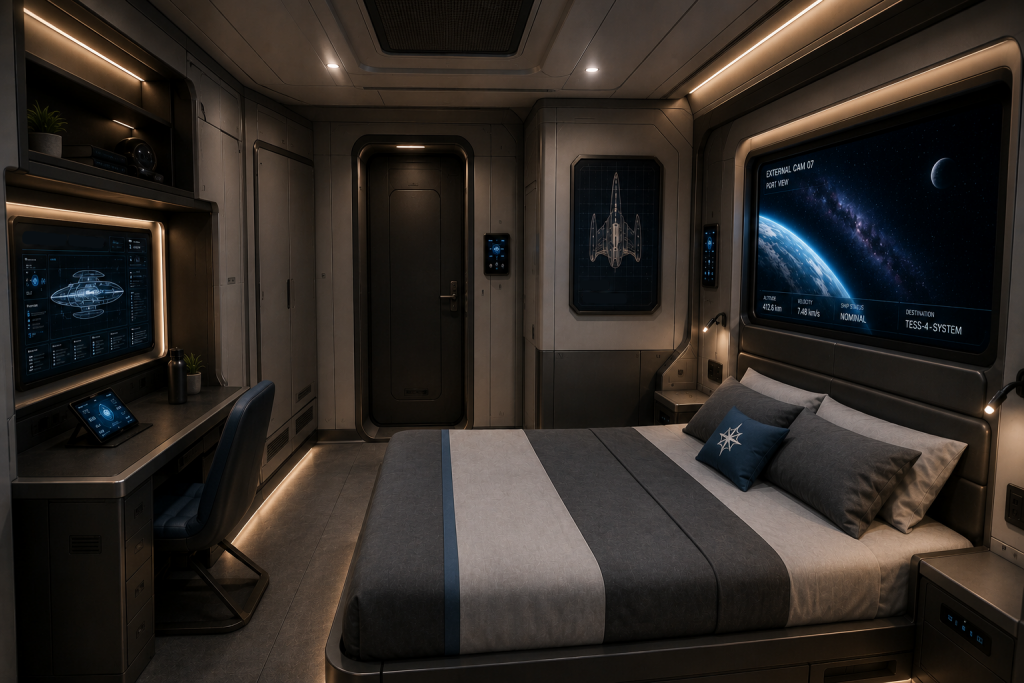
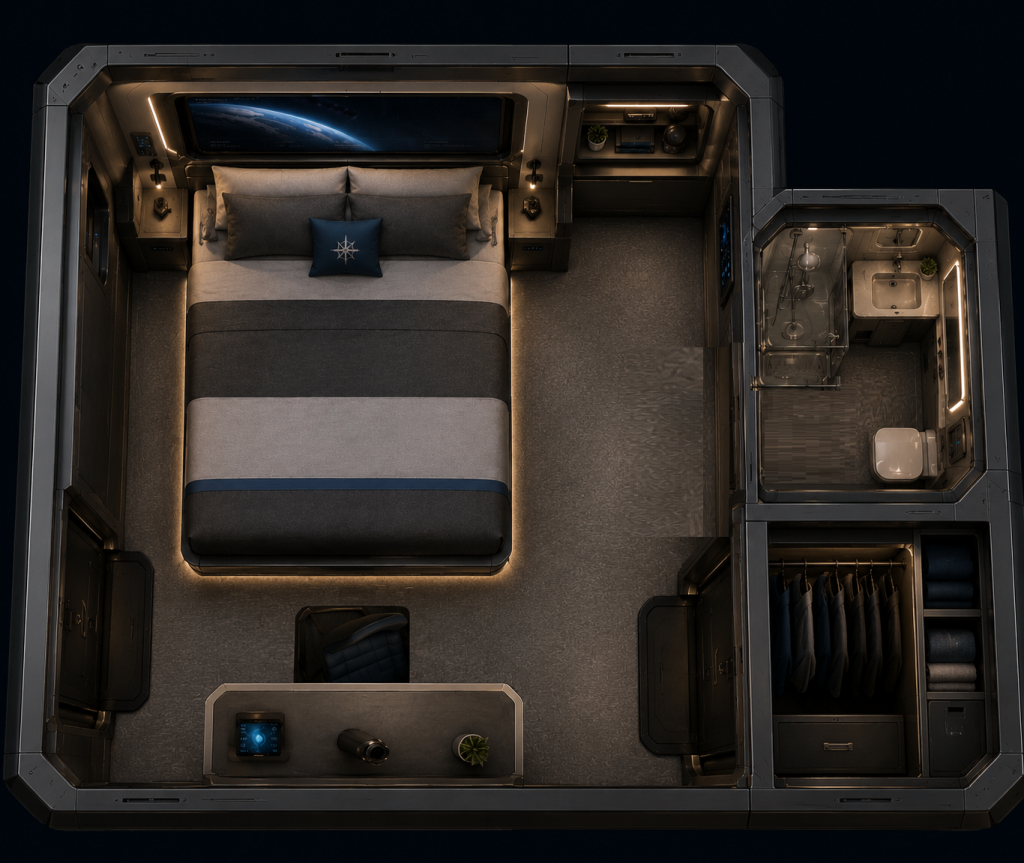
The Scout Class provides private accommodations for all crew members. Standard crew cabins include sleeping quarters, personal storage, workstation facilities, environmental controls, a private sanitary compartment, and a dedicated shower. Cabin design emphasizes privacy, comfort, and long-duration habitability while maintaining the operational character of an exploratory spacecraft.
The Captain receives a larger suite because of command responsibilities, but all crew have accommodations that are comfortable, private, and mission appropriate. The Chief Steward Cabin, and Chef Cabin very similar in size and amenities to the Crew Cabins with minor modifications based on position responsibilities. The ship’s design philosophy emphasizes professionalism, equality, and practicality rather than luxury hierarchy.
Standard Cabins
Standard Cabins feature:
Sleeping Area
- Full-size bed
- Reading light
- Personal storage drawers
- Emergency communications panel
Workstation
- Fold-down desk
- Terminal access
- Mission planning display
- Personal data access
Storage
- Wardrobe
- Uniform storage
- Luggage compartment
- Equipment locker
Private Head
- Toilet
- Sink
- Mirror
- Storage cabinet
Private Shower
- Enclosed shower stall
- Towel storage
- Drying rack
Environmental Controls
- Lighting controls
- Temperature controls
- Privacy settings
- Emergency alert display
Instead of windows:
- Ship status displays
- Simulated exterior views
- Mission information
- Entertainment
Chief Steward Cabin
This cabin functions as the residence and operational workspace for the Chief Steward. The Chief Steward is provided with an enlarged cabin that incorporates crew-services administrative functions, hospitality management facilities, and welfare-support operations. The cabin serves as both private accommodation and the primary workspace for crew support activities. The Chief Steward is frequently interacting with crew members and guests, so the cabin doubles as a small administrative office.
It is slightly larger than standard crew cabins and has the following additional features:
Steward Operations Desk used for:
- Crew welfare records
- Cabin assignments
- Logistics tracking
- Schedule management
Hospitality Storage, a small secure storage for:
- Guest supplies
- Cabin consumables
- Emergency comfort kits
Enhanced Communication Access for direct communication to:
- First Officer
- Medical Bay
- Galley
- Crew Services
Seating Area used as a small two-person meeting space for:
- Crew consultations
- Welfare discussions
- Guest assistance
Chef Cabin
The Chef is provided with private accommodations adjacent to the galley complex. The cabin includes standard crew amenities along with facilities supporting menu planning, inventory management, and food-service operations.
This arrangement fits well with the overall Crew Comfort Philosophy by providing every crew member with a private, self-contained living space while avoiding excessive luxury that would conflict with the exploratory nature of the vessel.
The cabin includes a small culinary workspace for
- Menu planning
- Inventory review
- Dietary tracking
There is direct communications to the:
- Steward
- First Officer
- Supply Management
Additional Storage is included for:
- Uniforms
- Culinary references
- Personal equipment
5.3.2 Sanitation Compartments
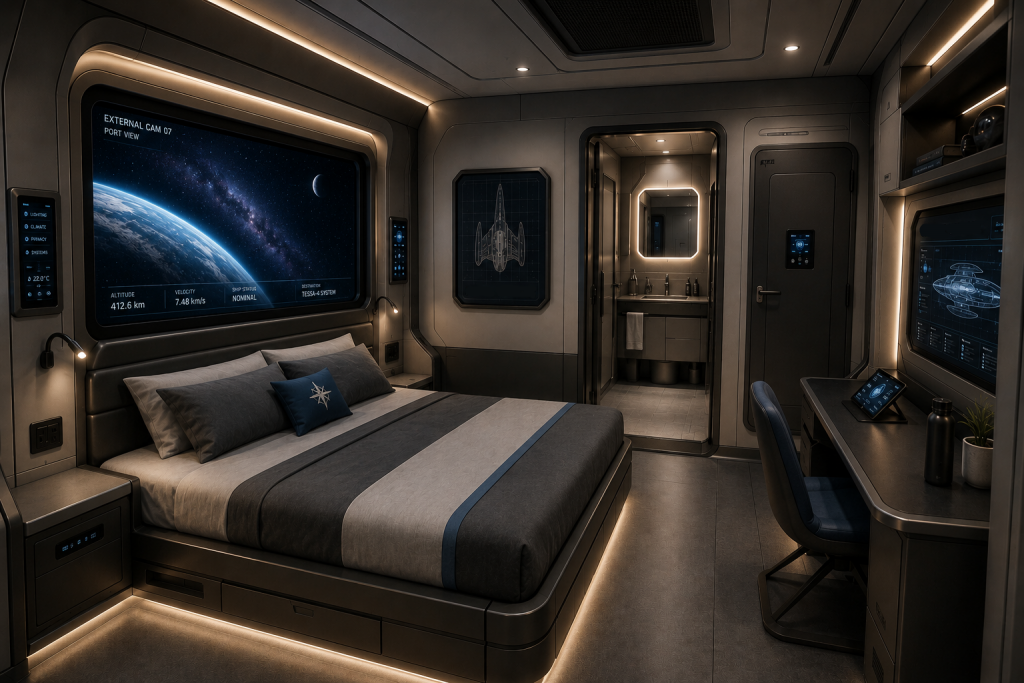
The Scout Class Starship has two standard Sanitation Compartment designs.
Type 1 Sanitation Compartments are adjoined to Crew Cabins. Each unit contains a vacuum-flush toilet, potable-water sink, shower, local ventilation, odor control, and emergency zero-gravity sanitation equipment. Access is provided by sealed sliding pocket doors. Features include:
- Potable water rinse
- Vacuum-assisted waste removal
- Minimal water use
- Sealed waste valve
- Odor isolation
- Automatic lid lock during pressure/vacuum events
- Foot restraint ridge at floor
- Side grab handles
- Occupancy sensor
- Manual override flush
Type 2 are public-area compact sanitation compartments installed near lounges, mission spaces, dining areas, bridge-adjacent spaces, and other shared-use zones. Each unit has the same features as Type 1 Sanitation Compartments without the shower.
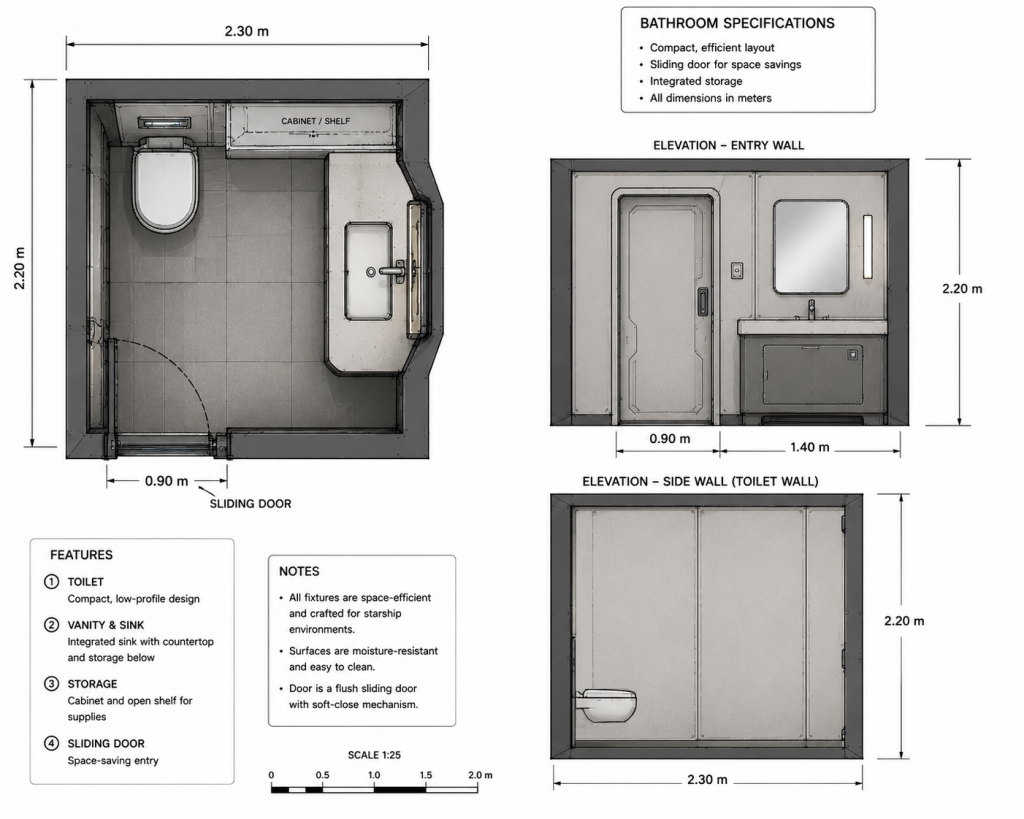
The compartments are constructed as a sealed stainless-steel wet module using radiused corners, non-slip flooring, corrosion-resistant fixtures, and removable service panels. All exposed surfaces are selected for durability, fire resistance, and rapid cleaning.
5.3.2.1 Lavatory Sink Assembly
Lavatory sinks are a compact stainless-steel basin integrated into a stainless or composite vanity module. They are 316L stainless steel with deep basin with rounded corners with a satin-brushed finish. The include integral overflow protection and are scratch and corrosion resistant.
The faucet assembly features include infrared occupancy sensors, manual touch override, temperature control, flowrate control and automatic shutoff. The can be controlled verbally through SCOUT.
In the event gravity fails they have vacuum assisted drains. The faucet will not produce a free-flowing stream of water. Instead, water emerges as controlled low-velocity flow providing misted steam directed as hygiene spray. Small vacuum slots around the basin rim are engaged to create a gentle airflow toward the sink. Any escaping droplets are drawn back into the basin and drainage system.
5.3.2.2 Mirror Assembly
Snart Mirrors are located above each sink and have the following functions:
- normal mirror
- cabin status display
- emergency instructions
- ship time
- environmental status
- medical alerts if required
The display remains hidden when not in use.
5.3.2.3 Waste Removal
The primary toilets operates under normal artificial gravity using a low-water vacuum-flush system similar in principle to aviation and marine sanitation systems. Potable water is used only for bowl rinse and hygiene; waste transport is performed by the ship’s vacuum waste system.
Because artificial gravity is not assumed to be continuously available during all emergency conditions, each head includes a recessed zero-gravity sanitation recess. This wall-mounted unit contains a deployable vacuum capture interface, restraint points, sanitary liners, and manual controls. In gravity-loss conditions, the user secures themselves with integrated foot loops and restraint straps while the vacuum capture system draws waste directly into the sealed waste trunk.
The recessed unit remains covered during normal operation and is clearly marked for emergency or low gravity use only.
5.3.3.4 Showers
Under normal operation, the shower behaves much like a high-end hotel shower. The guest enters a sealed shower enclosure and selects:
- Standard Shower
- Water Conservation Mode
- Quick Refresh Mode
Water is sprayed through low-flow atomizing shower heads and collected through vacuum floor drains.
The shower enclosure has a 316L stainless steel structural shell with composite decorative panels, tempered safety glass door, non-slip deck surface, rounded corners, and integrated handholds. The average size is 1.0m x 1.1m designed to feel comfortable while minimizing water consumption.
Shower water delivery uses an overhead spray ring for primary rinse and uniform coverage. A handheld wand provides for personal washing and cleaning compartment surfaces. Air-Assisted Atomizing Nozzles produce smaller droplets, lower water consumption, and improved cleaning
Vacuum Drainage is through the shower floor where perimeter vacuum slots are located around the floor edges. These continuously pull water, soap, moisture, and loose debris into the gray-water system.
Humidity Capture is accomplished through additional ceiling vents which continuously remove water vapor, humidity, and odors. The air is routed through condensers, filters, and water recovery equipment Recovered water is returned to the ship’s purification system.
5.3.3.4.1 Emergency Gravity-Loss Mode
If gravity fails while someone is showering:
- Water flow immediately stops.
- Vacuum collection increases.
- Restraint handles illuminate.
- Emergency instructions appear.
- The shower converts to a hygiene booth.
Rather than attempting a conventional shower in zero gravity, the compartment switches to Zero-G Hygiene Mode and uses the Vacuum Hygiene System where crew members secure themselves using foot restraints, waist restraint, and handholds. The handheld wand delivers warm water mist, soap, and rinse water. Simultaneously vacuum vents capture free droplets where air extraction prevents water from floating around the compartment. This allows personal hygiene without contaminating the cabin.
5.3.3.4.2 Emergency Sponge Bath Mode
For prolonged gravity loss the shower locker contains rinse-free body wipes, disposable washcloths, no-rinse shampoo, and hygiene kits. These provide a backup should water usage need to be restricted.
5.3.3 Medical Bay/Isolation Ward
The mission profile, crew size, and available space do not justify a full sickbay, but it must be capable of handling emergencies when outside assistance is unavailable. The primary purpose of the Med Bay is to:
- Stabilize injured personnel
- Treat common illnesses
- Perform minor surgical procedures
- Support telemedicine and AI-assisted diagnostics
- Sustain patients until evacuation or recovery
It is not intended for:
- Major trauma surgery
- Long-term hospitalization
- Intensive care of multiple patients simultaneously
The Main Treatment Area contains a Bio-Bed / examination table, a medical AI station, portable diagnostic equipment, isolation area, medical supplies, along with optional medical surgery capability.
The Primary medical station can monitor vital signs, ECG’s, Ultrasound Imaging, emergency trauma stabilization, automated CPR assistance and Integrated life-support monitoring.
The Medical AI acts as a medical assistant for conducting symptom analysis, drug interaction checking, procedure guidance, medical records management, telemedicine interface, and making emergency response recommendations.
The Isolation Room is a single negative-pressure room for housing crew with contagious illness, radiation exposure observation, psychological decompression, and patient privacy.
It maintains an independent air filtration system.
The Medical Bay is located on Deck 3 near the center of the ship , adjacent to crew/guest accommodations, and close to an elevator/stair core minimizing movement during emergencies.
5.3.4 Maintenance Workshops
- Spare parts storage
- Tool lockers
- Diagnostic equipment
- Hidden staff access routes
- Equipment replacement procedures